Imagine meeting someone in a café. You keep “table 12” in mind while carrying a drink, hear a name, and talk beside a window. The next day you can picture the window but cannot retrieve the name. Then a voice message arrives, and the name comes back. Meanwhile, you can still ride home without explaining how to balance a bicycle.设想你在咖啡馆认识了一位新朋友。端着饮料找座位时,你默念着“12 号桌”;坐下后听到对方的名字,在窗边聊了一会儿。第二天,你能想起那扇窗,却想不起名字。直到收到一条语音,名字才重新浮现。与此同时,你一直会骑车回家,尽管未必说得清身体如何保持平衡。
These are different memory problems: maintaining information for a current task, learning an association, recalling an event, and expressing a practiced skill. They can succeed or fail separately. Explaining memory therefore requires both a map of these abilities and a mechanism connecting experience to later behavior.这里有几种不同的记忆任务:为眼前的行动暂时保留信息,学会一组关联,回想一段经历,以及运用练熟的技能。它们可能分别成功,也可能分别出错。要理解记忆,需要先辨清这些能力,再解释一次经历怎样改变日后的行为。
Memory is a lasting influence of experience on the nervous system. Some of that influence supports conscious recollection; some changes what we can do without recollection. Momentary neural activity, changes in synaptic connections and the coordination of distributed brain networks contribute on different timescales.记忆是经历在神经系统中留下的、能够影响后续反应的变化。其中一部分使我们能够有意识地回想,另一部分让我们不必回想也能做得更好。短时的神经活动、突触连接的变化,以及分布式脑网络的协作,在不同时间尺度上参与其中。
One encounter, several ways of remembering一次见面,几种不同的记忆方式
“Short-term” and “long-term” describe duration. “Episodic,” “semantic” and “procedural” distinguish kinds of learned content or performance. Working memory additionally involves keeping information available for a task and using it. These classifications answer different questions; they are not compartments in a single sequence that every experience must pass through. Encoding means processing information into a form that can influence memory; retrieval means bringing previously learned information back into use.“短时”和“长时”描述保留的时间;“情景”“语义”和“程序性”区分记住的内容或表现出来的能力。工作记忆还强调为当前任务保留并使用信息。这些分类回答的是不同问题,不能把它们排成一列,认为所有经历都必须依次经过这些格子。把信息加工成可供记忆利用的形式,叫编码;让已经学过的内容重新参与当前活动,叫提取。
- 01 / WORKINGHold and use暂时保留,并加以使用
- Keep table 12 in mind while looking for it. Working memory depends on attention and task control interacting with the systems representing the information.一边寻找座位,一边记住 12 号桌。暂时记住桌号,需要表示该信息的神经系统,也需要注意和任务控制帮助保持它与当前目标的关系。
- 02 / EPISODICRecall an event回想一段经历
- Remember who was beside the window and what happened there. Episodic memory relates an event to its context; the hippocampal system is especially important for forming new such memories.想起谁坐在窗边、在那里发生了什么。情景记忆把事件与情境联系起来,海马系统对形成这类新记忆尤其重要。
- 03 / SEMANTICKnow a fact知道一项事实
- Know the person's name without recalling the first introduction. Semantic knowledge depends on distributed cortical representations; acquiring new factual knowledge can also depend on the medial temporal lobe.知道对方叫什么,却不必回想最初的自我介绍。语义知识依赖分布在皮层中的信息表示;学习新的事实也可能需要内侧颞叶参与。
- 04 / PROCEDURALPerform a skill掌握一种技能
- Balance and steer a bicycle. Different components of skill and habit learning recruit motor cortical, basal-ganglia and cerebellar circuits; knowing how need not include recalling each practice session.在骑车时保持平衡、调整方向。技能和习惯学习的不同部分涉及运动皮层、基底节、小脑等回路;会做,不要求记得每一次练习。
Episodic and semantic memory are commonly grouped as declarative memory: events and facts that can usually be consciously accessed. Nondeclarative memory includes more than skills; priming (such as processing a previously seen word more easily without recalling seeing it), conditioning and simpler forms of learning also belong here. Brief sensory persistence is another phenomenon. The four examples above are a reading map, not an exhaustive taxonomy; UTHealth’s learning and memory chapter develops the broader classification.情景记忆与语义记忆通常合称陈述性记忆,指通常能够有意识地提取的事件和事实。非陈述性记忆不只有技能,还包括启动效应、条件学习等。例如,见过一个词后,再识别它变得容易,却未必记得先前见过,这就是一种启动效应。感觉信息的短暂残留又是另一类现象。上面四个例子帮助我们建立阅读线索,并不是一份完整分类表;完整分类可参看 UTHealth《学习与记忆》教材章节。
The distinction matters when a name disappears from mind seconds after an introduction. Attention may have shifted before a useful association formed. Frontoparietal control networks can prioritize an item while content-related systems represent it. Maintenance can involve sustained activity, but information can also remain in a latent state. In a human experiment, Rose and colleagues (2016) applied brain stimulation after attention had shifted away from an item; information about it could again be decoded from EEG activity. The result argues against requiring continuously measurable activity for every retained item; it does not make working memory unlimited or identify a single universal storage mechanism.这一区分能解释为什么刚听到名字,几秒后就忘了:注意可能已经转向别处,还没来得及建立有效的关联。额顶控制网络参与确定当前应优先处理的内容,相关表征系统参与表示这些信息。维持信息可以伴随持续活动,也可能存在暂时不显露的状态。Rose 等人的人体实验(2016)在注意已经转向别处后施加脑刺激,使原先项目的相关信息又能够从脑电活动中被解码出来。这说明保留一项信息不一定要求始终测得到持续活动;它不意味着工作记忆没有容量限制,也没有确定一种适用于所有任务的存储机制。
How separate details become one episode海马怎样把分散细节关联成一次经历
A face, a voice and a location are represented by activity across partly different neural populations. A representation is a pattern of activity that carries information about something; it is not a tiny image stored inside one neuron. Remembering the encounter requires linking these components so that a later cue can help reinstate aspects of their relationship.面孔、声音和位置的信息,由部分不同的神经元群体共同表示。所谓“表征”,是携带某种信息的活动模式,并不是某个神经元里装着一张微型照片。要记住这次见面,还需要把这些成分联系起来,使日后的一个线索能够帮助重新唤起它们之间的关系。
The hippocampus, deep within the medial temporal lobe, receives already-processed information through surrounding cortical regions and participates in rapidly forming these relational representations. In the hippocampal indexing theory (Teyler and DiScenna, 1986), hippocampal activity helps connect distributed cortical patterns. The useful part of the “index” analogy is cue-based reinstatement. The hippocampus is itself plastic and represents information; it is not a passive address table, and the cortex participates from the beginning.海马位于内侧颞叶深部,通过周围皮层区域接收已经加工过的信息,参与快速形成这些关系表征。海马索引理论(Teyler 与 DiScenna,1986)认为,海马活动能够帮助联系分布于皮层的模式。“索引”这个比喻有用的地方,是说明线索怎样帮助重新唤起关联内容。海马自身也会发生可塑性变化、表示信息,并非一张被动的地址表;皮层从最初编码时就已经参与。
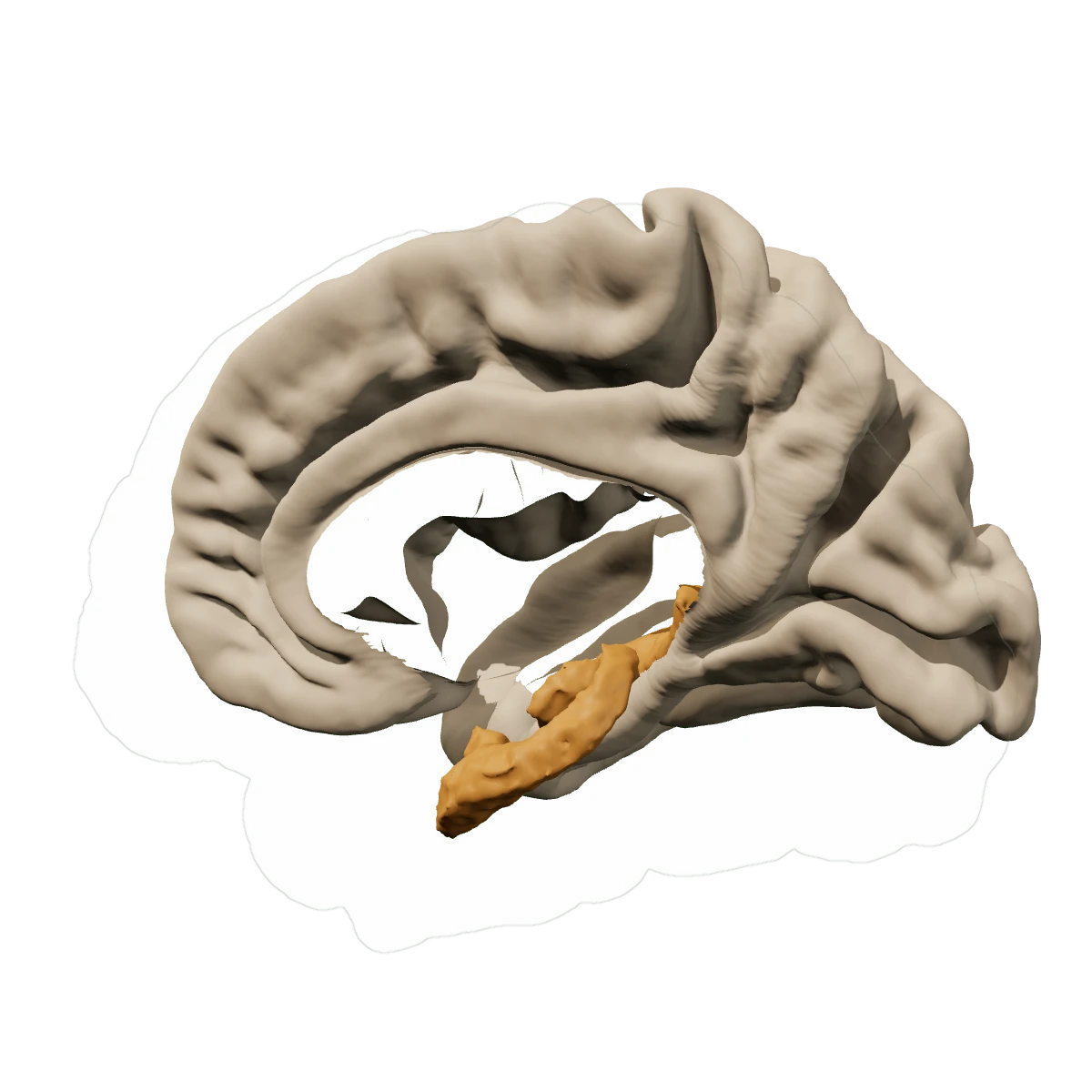 Drag to rotate拖动旋转
Hippocampus海马
The folded surface is the cerebral cortex. Different cortical networks help represent sensory features, concepts and the context of an experience. The hippocampi are hidden beneath this surface.有沟回的表面是大脑皮层。不同皮层网络参与表示感觉特征、概念与经历的情境。海马位于这层表面的深处。
Gold marks the hippocampi on both sides. The left hemisphere’s surface is hidden, leaving its outline so the hippocampi can be seen in the medial temporal lobes. The structures remain in their anatomical positions.金色部分是两侧的海马。隐去左半球表面、保留外形轮廓,就能看清它们位于内侧颞叶深部。各结构保留原来的相对位置。
Each hemisphere has a hippocampus. Here the surrounding surface is hidden and the camera moves closer. These curved structures participate in binding an event's details; they are not containers holding an entire memory.左右半球各有一个海马。这里隐去周围表面、拉近视角,便于观察它们弯曲的形态。海马参与关联一次经历的细节,并非装着完整记忆的容器。
FreeSurfer fsaverage reference surfaces and hippocampal segmentation share one coordinate frame. Colour distinguishes structures; the cerebellum, brainstem and other deep structures are omitted. This is reference anatomy, not a map of memory activity.基于 FreeSurfer fsaverage 参考脑表面与同坐标海马分割。配色用于区分结构,省略小脑、脑干及其他深部结构;这是参考解剖,不表示记忆活动或某个人的精确形态。
- 1Face · visual features and identity.面孔 · 视觉特征与身份。
- 2Name · sounds and learned meaning.名字 · 语音与已知含义。
- 3Place · the café and its spatial context.地点 · 咖啡馆及其空间背景。
- 4Time · the event's temporal context.时间 · 事情发生的时间背景。
- HHippocampal binding · rapidly associates distributed representations of the same event.海马参与关联 · 快速联系同一次经历的分布式表征。
After bilateral medial-temporal surgery, patient H.M. had severe difficulty establishing new lasting memories of events and facts, despite retaining important perceptual, intellectual and short-term abilities. The original Scoville–Milner report (1957) linked the deficit to medial-temporal damage. Later motor-skill observations reported by Corkin (1968), showing learning despite profound amnesia, helped establish that memory is not a single faculty.患者 H.M. 接受双侧内侧颞叶手术后,很难形成新的、持久的事件与事实记忆,但仍保留一些重要的知觉、智力与短时记忆能力。Scoville 与 Milner 的原始报告(1957)把这类障碍与内侧颞叶损伤联系起来。后来,Corkin 的运动技能研究(1968)观察到,他在严重遗忘的情况下仍能通过练习提高成绩,进一步说明记忆并非一种单一能力。
His lesion was not restricted to the hippocampus, and neither every old memory nor every kind of new learning behaved identically. The case supports a division of labor among memory systems; it cannot establish that all memories are stored in one anatomical structure.他的损伤并不只限于海马,旧记忆和新学习也并非整齐地一类全保留、一类全丢失。这个病例支持记忆系统之间存在分工,不能用来证明所有记忆都储存在某一个脑结构里。
Pattern separation means transforming similar inputs into more distinct neural representations; pattern completion means reinstating an associated representation from a partial cue. Two visits to the same café need to remain distinguishable, while one voice may help recover more of a particular visit. Bakker and colleagues’ human imaging study (2008) examined separation-related responses; Nakazawa and colleagues’ mouse CA3 experiment (2002) tested recall under incomplete spatial cues. These studies approach the operations at different levels; behavior alone cannot identify the cells or subfields responsible.模式分离指相似输入被转化为差异更大的神经表征;模式补全指不完整线索使既有的关联表征重新激活。需要区分两次去同一家咖啡馆的经历,而一段声音又可能唤起某次见面的更多内容。Bakker 等人的人体成像研究(2008)考察了与模式分离有关的响应;Nakazawa 等人的小鼠 CA3 实验(2002)检验了空间线索不完整时的回忆。这些研究从不同层次接近上述操作;单凭一个行为,仍不能确定由哪些细胞或海马亚区完成。
What remains after the activity has passed?神经活动结束后,究竟留下了什么
The electrical activity evoked during a conversation is transient. For the conversation to influence tomorrow, something about the nervous system must persist or change. Neurons communicate at junctions called synapses. One major mechanism is synaptic plasticity: a change in how effectively one neuron influences another through such a junction. Changes in cellular excitability, inhibition and circuit structure also contribute. A remembered name cannot be equated with a single strengthened synapse.谈话当时引起的电活动是短暂的。要让它影响明天,神经系统中就必须有某些状态得以保留,或发生相对持久的变化。神经元之间传递信号的接点叫突触。一种重要机制是突触可塑性:一个神经元经由这个接点影响另一个神经元的效能发生改变。细胞兴奋性、抑制作用和回路结构的变化也会参与。记住一个名字,不能等同于加强了某一个突触。
A useful example is NMDA-receptor-dependent long-term potentiation, or LTP, at a typical excitatory connection from the hippocampal CA3 subregion to CA1. Here AMPA and NMDA denote two types of glutamate receptors whose channels allow ions to cross the cell membrane. Glutamate released by the presynaptic neuron activates AMPA receptors, producing a postsynaptic depolarization: the inside becomes less negative relative to the outside. Sufficient depolarization relieves the voltage-dependent magnesium block of NMDA receptors. When glutamate and a co-agonist such as glycine or D-serine are also bound, calcium can enter and initiate signaling that changes synaptic efficacy, including AMPA-receptor function or availability. Hayashi and colleagues (2000) directly investigated activity-dependent delivery of AMPA receptors into synapses.可以先看海马 CA3 亚区通向 CA1 亚区的兴奋性突触中的一种典型机制:依赖 NMDA 受体的长时程增强,简称 LTP。AMPA 与 NMDA 是两类谷氨酸受体,它们的通道允许离子跨过细胞膜。突触前神经元释放谷氨酸,激活 AMPA 受体,引起突触后去极化,也就是膜内相对膜外的电位变得不那么负。去极化达到适当程度时,NMDA 受体通道中与电压有关的镁离子阻塞得到缓解。同时,谷氨酸以及甘氨酸或 D-丝氨酸等共激动剂也需要与受体结合,钙离子才能经通道进入,启动改变突触效能的信号过程,包括改变 AMPA 受体的功能或可用数量。Hayashi 等人(2000)直接研究了活动依赖的 AMPA 受体进入突触的过程。
- 1. Released glutamate activates AMPA receptors; inward current depolarizes the postsynaptic membrane.1. 谷氨酸激活 AMPA 受体,内向电流使突触后膜去极化。
- 2. Sufficient depolarization relieves NMDA receptors' Mg²⁺ block. With glutamate and a co-agonist bound, Ca²⁺ can enter.2. 充分去极化解除 NMDA 受体的 Mg²⁺ 阻塞;谷氨酸和共激动剂都与受体结合时,Ca²⁺ 得以进入。
- 3. Ca²⁺ signalling can activate enzymes such as CaMKII, changing AMPA receptor function and bringing more receptors into the synapse.3. 钙信号可激活 CaMKII 等酶,改变 AMPA 受体的功能,并使更多受体进入突触。
- 4. Later glutamate input can evoke a larger postsynaptic response. Persistent change involves additional mechanisms.4. 后续谷氨酸输入可引起更大的突触后响应;变化的长期维持还涉及其他机制。
The critical consequence is a changed input–response relationship: a later comparable input can produce a larger postsynaptic response. Requiring both transmitter input and sufficient depolarization makes NMDA receptors a coincidence detector; the changed response explains how the past can influence the future. More persistent forms of plasticity can recruit protein synthesis and structural change. Other synapses use other mechanisms, and long-term depression can weaken transmission. “More strengthening” is not a general recipe for better memory.关键结果是输入与响应的关系改变了:日后相近的输入,可能引起更强的突触后反应。递质输入与充分去极化需要同时出现,使 NMDA 受体具有检测活动重合的作用;增强后的响应说明,过去怎样影响未来。更加持久的可塑性还可能需要蛋白质合成和结构变化。其他突触可以采用不同机制,长时程抑制也能减弱传递。因此,“连接越强,记忆越好”并不是普遍规律。
The classic Bliss–Lømo experiment (1973) demonstrated prolonged enhancement after electrical stimulation of the perforant-path input to the dentate gyrus in anaesthetized rabbits. That pathway differs from the CA3–CA1 example used above to explain the molecular mechanism. It established a physiological phenomenon, not a direct recording of a remembered episode. A separate line of work studies engrams: cellular ensembles participating in a memory trace. In Liu and colleagues' mouse study (2012), mice first learned an association between a context and an electric shock. Later reactivation of tagged hippocampal cells elicited freezing, a defensive response in which the animal becomes still. That is causal evidence about a learned behavioral response in mice, not a method for reading a person's autobiographical recollection.经典的 Bliss–Lømo 实验(1973)显示,在麻醉兔的穿通路—齿状回通路中,电刺激后的突触传递可以较长时间地增强。这与上文解释分子机制时采用的 CA3–CA1 突触,并非同一条通路。它确立了一种生理现象,并不是直接记录到了某段被记住的经历。另一条研究路线关注记忆痕迹细胞群,亦称 engram。在 Liu 等人的小鼠实验(2012)中,研究者先让小鼠学习环境与电击之间的关联,之后重新激活被标记的海马细胞,可以引起冻结行为,即动物保持静止的一种防御反应。这是关于小鼠学习后行为反应的因果证据,并非读取人类自传式回忆的方法。
Consolidation changes a memory's support巩固改变了记忆赖以维持的条件
The conversation can end while memory processing continues. Synaptic consolidation concerns cellular processes that stabilize changes after learning. Systems consolidation concerns how interactions among brain regions supporting a memory change over time. Their timescales overlap and vary with the task; a fixed deadline such as “the brain saves a memory after one night” confuses the two.谈话结束,并不意味着与记忆有关的处理也随之结束。突触巩固关注学习后稳定细胞变化的过程;系统巩固关注支持一段记忆的脑区协作怎样随时间改变。两者的时间尺度存在交叠,也随任务而变化,不能简单规定“睡一晚,大脑才把记忆存好”。
During later rest and sleep, aspects of earlier activity can be reactivated. In rats, Wilson and McNaughton (1994) observed experience-related hippocampal ensemble reactivation during sleep. Such reactivation is not a frame-by-frame replay of a conscious movie. The broader proposal is that repeated coordinated activity can modify relationships among representations and help some memories become more stable or integrated with prior knowledge.在随后的休息和睡眠中,先前活动的某些模式可能再次出现。Wilson 与 McNaughton(1994)在大鼠中观察到,与先前经历有关的海马细胞群活动在睡眠时重新显现。这种再激活不等于在意识里逐帧播放录像。更广泛的机制解释是,反复协调的活动能够改变表征之间的联系,使部分记忆更稳定,或更容易融入已有知识。
Cortical activity represents components of the event. Hippocampal circuits rapidly associate them.皮层活动表征事件的不同成分,海马回路快速建立它们之间的关联。
Some cortical relationships strengthen or reorganize. Detailed episodic recollection can still involve the hippocampus.部分皮层联系加强或重组。回想细节丰富的个人经历,仍可能需要海马参与。
Evidence also challenges a simple transfer picture. In Kitamura and colleagues’ mouse experiment (2017), a prefrontal memory ensemble was established at initial fear learning and matured later. In that task, consolidation changed how an already distributed trace could support retrieval; the cortex did not start empty and receive a finished memory afterward.实验也不支持简单的“搬运”图景。在 Kitamura 等人的小鼠实验(2017)中,前额叶的记忆细胞群在最初恐惧学习时就已形成,随后逐渐成熟。在这一任务中,巩固改变的是已有分布式痕迹怎样支持提取,而不是向原本空白的皮层交付一份完成品。
The human evidence includes interventions, not just recordings. Rasch and colleagues (2007) paired an odor with spatial learning and presented it again during slow-wave sleep; under their experimental conditions, this improved subsequent retention. It supports sleep-related reactivation of previously learned material. It does not show that people can learn an unfamiliar textbook simply by playing it while asleep.人体证据也包含干预实验,而不仅是记录活动。Rasch 等人(2007)把一种气味与空间学习配对,再在慢波睡眠期间呈现气味;在该实验条件下,后续记忆表现得到改善。它支持睡眠中重新激活已学内容的作用,不能据此认为把陌生教材在睡眠时播放,就能直接学会。
How long does the hippocampus remain necessary? A standard consolidation account predicts that some memories become less dependent on it as cortical support develops. Multiple-trace and transformation accounts emphasize a continuing hippocampal contribution to richly detailed episodic recollection, while more schematic knowledge may be supported differently. The disagreement concerns what is retained and how it is retrieved. Bonnici and colleagues (2012) could distinguish individual vivid autobiographical memories from human hippocampal activity patterns, both for recent events and for events approximately ten years old. This demonstrates involvement, not necessity in every case; it rules out treating hippocampal participation in old memories as a closed question.海马会一直必不可少吗?标准巩固理论预测,随着皮层支持的发展,一部分记忆会降低对海马的依赖。多重痕迹与转化理论则强调,细节丰富的情景回想仍可能需要海马,而概括化的知识可以获得不同的支持。分歧涉及保留了什么内容,以及怎样提取它。Bonnici 等人(2012)发现,无论是近期经历,还是大约十年前的经历,不同的鲜明自传体回忆都能通过海马活动模式加以区分。这显示海马参与其中,不能证明它在每种情况下都必不可少;但也提醒我们,旧记忆与海马的关系并没有一个可以一概而论的答案。
A cue helps reconstruct an event提取,是在线索帮助下重建经历
Return to the missing name. The voice message supplies a cue connected with the encounter, making the relevant association easier to reactivate. Failure without that cue did not prove that all traces of the name had vanished. In Tulving and Pearlstone’s word-list experiment (1966), category cues improved recall relative to an uncued condition. Recognition and free recall also make different demands: choosing a familiar name from a list supplies more external information than producing it unaided.回到那个想不起的名字。语音提供了与见面经历相关的线索,使相应关联更容易重新激活。没有线索时想不起来,并不能证明名字的所有痕迹都已消失。在 Tulving 与 Pearlstone 的词表实验(1966)中,给出类别名称作为线索时,受试者比没有线索时能回忆出更多词。再认和自由回忆的要求也不同:从一列名字中认出熟悉的一个,比不看选项、自己说出名字,多了一部分外部信息。
Reinstatement is selective. A remembered scene combines recovered details with existing knowledge and current expectations. You might correctly remember the window while inferring that a cup was on the table because that would be typical. Distinguishing “I perceived this” from “this is plausible” is a source-monitoring problem. A vivid or confident recollection is therefore not, by itself, a guarantee of accuracy. In Loftus and Palmer’s accident-film experiments (1974), the wording of a question affected speed estimates and later reports of nonexistent broken glass. The behavior shows an influence of post-event information, without by itself proving that the original trace was erased.重新唤起的内容具有选择性。回想一个场景时,提取出的细节会与已有知识、当前预期共同参与。你可能确实记得窗户,却因为咖啡馆通常如此,推测桌上放着一只杯子。区分“我当时看到了”和“这样很合理”,涉及对信息来源的判断。因此,回忆很鲜明、自己很确信,都不能单独保证它准确。在 Loftus 与 Palmer 的事故影片实验(1974)中,问句的措辞会影响速度估计,以及后来对实际未出现的碎玻璃的报告。这说明事件后的信息能影响回忆报告,单靠它还不能证明原有痕迹被抹掉了。
Retrieval can also change subsequent memory, but not every retrieval destabilizes a trace. In Nader, Schafe and LeDoux's rat experiment (2000), disrupting protein synthesis in the amygdala after reactivating a conditioned fear memory impaired later expression. This helped establish experimental reconsolidation. Whether reactivation opens such an updating window depends on conditions, including the memory and the reactivation procedure; “every recall overwrites the memory” is too strong.提取本身也可能改变后续记忆,但不是每次提取都会使原有痕迹变得不稳定。在 Nader、Schafe 与 LeDoux 的大鼠实验(2000)中,重新激活条件性恐惧记忆后,干预杏仁核中的蛋白质合成,会损害后来该记忆的行为表现。这是记忆再巩固的重要实验证据。不过,能否打开这样的更新窗口,取决于记忆特点、再激活方式等条件;“每次回想都会覆盖原记忆”说得过头了。
Forgetting has more than one cause想不起来,可能有几种不同原因
The same answer—“I don't remember”—can arise at different points. These distinctions organize possible explanations; they are not a way to diagnose an individual's brain from one mistake.同一句“我不记得了”,可能来自不同环节。区分这些环节,是为了理解可能的解释,不能凭一次忘事就判断一个人的脑功能出了什么问题。
- The association was weakly encoded最初就没有形成清楚的关联
When you heard the name, your attention was on finding a seat. Later difficulty may reflect what was learned initially, rather than the loss of a once-complete record.听到名字时,你的注意力还在找座位这件事上。后来想不起,可能与当初学到了多少有关,而不是一份曾经完整的记录后来丢失了。
- The present cue is ineffective眼前的线索没能唤起它
The name fails to come to mind at home but returns when you hear the voice. Accessibility depends partly on the relation between learning and retrieval conditions.在家想不起名字,听见声音却想起来了。能否提取,部分取决于学习时的关联与当前线索是否接得上。
- Similar experiences interfere相似经历彼此干扰
Two introductions, or two visits to the same place, compete for overlapping cues. Old learning can interfere with new learning, and new learning with later access to older material.两个人的自我介绍,或两次在同一地点的见面,可能共用相似线索。旧学习会干扰新学习,新学习也会影响后来对旧内容的提取。
- The underlying trace has changed支持记忆的痕迹发生了变化
Plasticity, updating and other biological changes can alter what is retained. A failed behavioral test alone cannot cleanly distinguish inaccessible information from information that no longer persists in a recoverable form.可塑性、更新和其他生物学变化,能够改变保留下来的内容。仅凭一次行为测验中的失败,很难严格区分“目前无法提取”与“已经不再以可恢复的形式保留”。
Forgetting can sometimes reduce interference and allow behavior to adapt when circumstances change. That does not make every loss useful, or imply that every forgotten detail remains hidden forever. Ordinary forgetting has multiple mechanisms, and no single universal decay curve describes all people, materials and testing conditions.有些遗忘有助于减少干扰,让行为适应已经变化的情境。但这不意味着每一种丢失都有好处,也不意味着忘掉的每个细节都会永远潜藏在脑中。遗忘有多种机制,并不存在一条能精确描述所有人、所有材料与测验条件的通用衰减曲线。
What this changes about learning把机制落实到学习方法
A mechanism suggests a hypothesis about learning; behavioral experiments must test whether a method actually helps. “LTP exists” cannot establish an optimal study schedule. The most useful practical distinction is between the ease of processing material while it is visible and the ability to retrieve it later without that support.机制可以启发学习方法,但方法有没有效果,还需要行为实验检验。不能因为存在 LTP,就直接推导出最佳复习时间表。最值得把握的区别是:材料摆在面前时读得顺不顺,与离开材料后能不能独立想起来,是两件事。
In Roediger and Karpicke's experiments (2006), students learned prose passages through repeated study or retrieval practice. Repeated study could produce better immediate performance, while retrieval practice improved retention on delayed tests. The result supports practicing retrieval, rather than using familiarity during rereading as the sole measure of learning. Checking an attempted answer against the material also reveals omissions and errors.在 Roediger 与 Karpicke 的实验(2006)中,学生通过反复阅读或提取练习学习短文。反复阅读可以带来更好的即时表现,而提取练习在延迟测验中有利于保持。这支持我们主动练习回忆,而不是只凭重读时的熟悉感判断是否学会。尝试回答后再对照原文,也能发现遗漏和错误。
Spacing study opportunities changes the retention problem too. In Cepeda and colleagues’ fact-learning experiment (2008), the best review interval varied with the delay to the final test. The useful interval depends on the retention goal and how well the material can still be retrieved. Sleep offers conditions that support some consolidation processes; it cannot compensate for material that was never adequately learned. Organizing an explanation around causal relationships can provide more useful retrieval cues than memorizing disconnected terminology.把学习分散到不同时间,也会改变保持效果。Cepeda 等人的事实学习实验(2008)发现,最有利的复习间隔随最终测验的延迟而变化。因此,安排间隔需要考虑希望记住多久,以及当时是否还能提取。睡眠为部分巩固过程提供了条件,却不能补上从未认真学过的内容。把解释组织成有因果关系的结构,通常也比孤立记术语更容易形成有用的提取线索。
The café encounter is remembered because experience changes a distributed system, and later conditions allow some of that information to influence present activity again. Working memory makes information usable now; hippocampal interactions help relate details of new episodes; plasticity and consolidation change their longer-term support. Retrieval draws on those changes while remaining selective and reconstructive. That explains both the reach of memory and why remembering is never a guarantee of exact reproduction.那次咖啡馆见面能够被记住,是因为经历改变了一个分布式系统,后来的条件又使其中一部分信息能够重新影响当前活动。工作记忆让信息在眼前可用,海马与相关区域的协作帮助关联新经历的细节,可塑性与巩固改变它们长期维持的条件。提取借助这些变化,同时仍有选择和重建。因此,记忆能够让过去影响现在,却不保证把过去原样重现。