Start with the force, not the motor rating先看整车能得到多少力
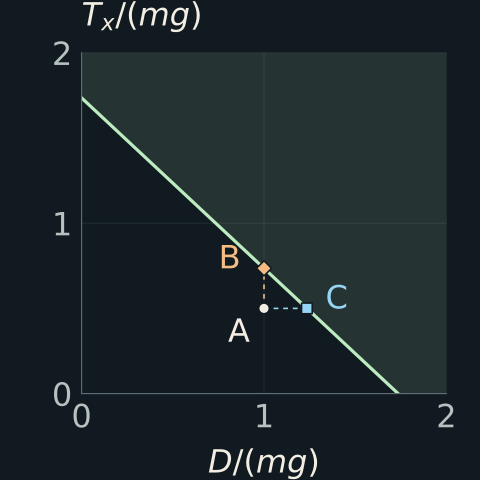
Suction increases the force tyres can transmit; a jet adds force directly to the car. The difference is geometric: one enlarges the tyre-force circle, the other shifts the total-force envelope. Here forward force is horizontal, cornering force vertical, and one unit is the car’s weight,
Available forward force Fₓ,max 可用纵向力 Fₓ,max
mg
mg
mg
Change side force to compare all three cases.改变侧向力,同时比较三种情况。
The horizontal line fixes the side force. Its rightmost intersections give the forward-force limits. 水平线固定侧向力;各条边界右侧的交点给出纵向力上限。
Figure 1 · μ = 1; N = mg + D. Suction expands the tyre-force circle. Fixed forward thrust shifts the total force envelope:
Ideal force capacity, not measured Tesla acceleration. Drive/brake limits, tyre load sensitivity, drag, load transfer and gas duration are excluded. Negative Fₓ includes braking.这是理想可用力,不是特斯拉实测加速度;未计入驱动/制动限制、轮胎载荷敏感性、阻力、载荷转移与储气时长。横轴负向包含制动。
The strongest illustrative case reaches 2.50g in a straight line if the drivetrain can use all the grip. A full, no-rollout second from rest to 60 mph requires 2.74g on average. Even the ideal example falls short: held constant, its best time is 1.094 s. These are model results, not Roadster measurements.图中最强的示例,在电驱能用足全部抓地力时,直线加速度达到 2.50g。真正从静止开始,不扣除 rollout,在完整一秒内达到 60 mph,需要平均约 2.74g。示例即使全程保持理想上限,最快也需 1.094 秒。这些是模型结果,不是 Roadster 实测。
That gap gives us a design problem: how much suction or direct thrust would close it? Then the harder tradeoff: when does the fan consume more useful drive power than its extra grip is worth?由此可以反算设计条件:增加多少吸附力或直接推力,才能补上差距?接着再算代价:什么时候,风扇占用的驱动功率会抵消新增抓地力的收益?
What the Roadster demonstration shows从 Roadster 的演示看起
Tesla’s 15 October 2026 Roadster event, featuring Elon Musk and the engineering team, puts both ideas on display. Its published sequences include inverted contact on a ramp and an airborne roll. The useful engineering question is how electric drive, fan suction and cold-gas thrust work together—and how their limits move as the car accelerates, turns or leaves the surface.2026 年 10 月 15 日,Elon Musk 与工程团队参与的 Tesla Roadster 发布活动,把这两条思路放到了同一辆车上。官方影像包括倒置坡道上的贴附与空中翻滚。理解这些动作,需要看电驱、风扇负压与冷气推进怎样协同,以及车辆加速、转向、离开表面时,限制条件怎样随之变化。
- Performance
- Active aerodynamics and multi-mode suction.主动空气动力装置与多模式负压系统。
- Thrust
- Adds rear cold-gas thrusters.增加车尾冷气推进器。
- Rocket
- Perimeter thrusters provide upward and forward thrust and rotation. Not approved for public roads.周向推进器提供向上、向前与旋转能力,未获公共道路使用批准。
According to Tesla’s configuration descriptions, checked 17 October 2026; not independently tested.据 Tesla 配置说明,核对日期为 2026-10-17;未经独立测试。
The analysis below uses force schematics and explicitly assumed values, not Tesla’s internal design data. The demonstrations show particular manoeuvres; endurance and repeatability require separate measurements.下文使用受力示意与明确假设的数值,不代表 Tesla 的内部设计数据。演示展示了特定动作;持续能力与重复性,需要另外测量。
Electric drive still has to pass through the tyres电机很强,为什么仍会受轮胎限制?
In a battery-electric drivetrain, power electronics regulate the motor, and a transmission delivers torque to the wheels. The motor creates torque through electromagnetic interaction. At the contact patch, a driven tyre pushes the road backwards; the road’s forward force accelerates the car. Increasing motor torque helps only while the tyre can transmit the resulting force.电驱系统中,功率电子装置调节电机,传动机构把转矩传给车轮。电机通过电磁相互作用产生转矩;驱动轮在接触区向后推地面,地面对轮胎的向前作用力才使整车加速。电机继续增加转矩是否有用,取决于轮胎还能不能把这部分力传出去。
U.S. Department of Energy: the battery-electric drivetrain美国能源部:纯电动车的动力传递路径
Here wheel torque
OpenStax: friction as an approximate contact-force modelOpenStax:摩擦力的近似接触模型
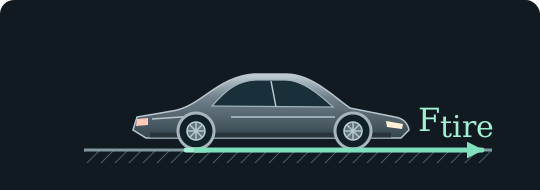
The road supplies the force. More torque helps while grip remains.路面提供驱动力;还有附着余量,增加转矩才有用。
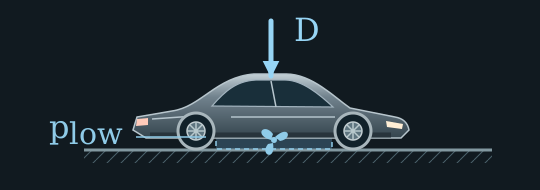
Pressure difference adds load without an equivalent mass of ballast.压差增加法向载荷,无需加入等重配重。
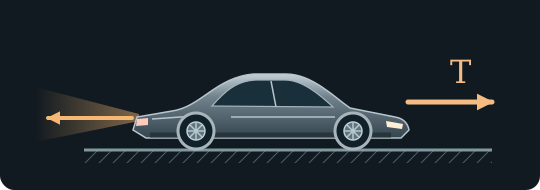
Exhaust carries momentum away; the chassis receives thrust directly.排气带走动量,车身直接获得反向推力。
On a level road, with negligible vertical acceleration and no vertical thruster force, the total normal load is
Acceleration and cornering also share the tyre’s available force. In a simple friction-circle approximation,
University at Buffalo: coupled longitudinal and lateral tyre forces布法罗大学:轮胎纵向力、横向力与滑移的耦合
Suction works by maintaining a pressure difference负压怎样把车压在路面上?
Imagine a shallow chamber between the floor of the car and the road. A fan removes air; a skirt or sealing system limits air leaking back in. Pressure underneath becomes lower than the surrounding pressure. Integrating that pressure difference over the effective area produces a force toward the road. It can exist while the car is stationary, because the fan is doing the work of moving air.把车底与路面之间想象成一个浅腔:风扇向外抽气,裙边或密封结构限制外界空气补进来,车底压强便低于周围环境。把压差在有效面积上累加,就得到朝向路面的力。车辆静止时它也能存在,因为此时负责搬运空气的是风扇。
For a scale example only, let the average pressure difference be 5 kPa over 2 m². Then the added force is 10 kN—about the weight of one tonne. Neither number is a Roadster specification. The example shows why a modest fraction of atmospheric pressure, acting over a large area, can produce a substantial force.只做一个数量级例子:假设平均压差为 5 kPa,有效面积为 2 m²,得到的附加力就是 10 kN,约等于一吨物体的重量。这两个数都不是 Roadster 参数。它说明:相对于大气压不算大的压差,作用在较大面积上,也能产生相当大的力。
NASA Glenn: summing surface pressure into aerodynamic forceNASA Glenn:如何把表面压强累加成合力
Conventional wings and underbody aerodynamics depend on incoming airflow. With a downforce coefficient
NASA Glenn: force scaling with airflow speed and areaNASA Glenn:气动力与来流速度、面积的关系
Maintaining that pressure costs power. In a simple low-speed airflow estimate, fan shaft power is of order
Tesla’s description of its fan and ground-sealing systemTesla 对风扇与地面密封系统的说明
Why not simply make the car heavier? In the same constant-friction, all-wheel traction model, added ballast increases available force and inertia together:
Cold gas adds thrust by throwing mass away冷气推进:把质量抛出去,换来推力
A cold-gas system stores pressurised gas, opens a controlled valve and expands the gas through a nozzle. The escaping gas carries momentum; the vehicle receives the opposite impulse. No combustion is required at the nozzle. “Cold” does not mean energy-free: energy was invested when the gas was compressed, and that stored capacity to do work is spent during discharge.冷气系统先储存受压气体,随后打开受控阀门,让气体经过喷嘴膨胀、加速。排出的气体带走动量,车辆获得反方向的冲量。喷嘴里不需要燃烧。“冷”也不意味着不耗能:压缩阶段已经投入能量,排气时消耗的是预先储存的做功能力。
NASA: cold-gas propulsion and its storage constraintsNASA:冷气推进与储存约束
For the Roadster, Tesla specifically describes carbon-fibre overwrapped pressure vessels (COPVs) and new thruster hardware and controls for vehicle operation. A COPV is a pressure vessel reinforced by a composite overwrap; it stores the supply, while valves and nozzles govern how that supply becomes thrust. The public description does not provide a complete pressure, gas-mass or duty-cycle specification.针对 Roadster,Tesla 明确提到碳纤维缠绕压力容器(COPV),以及为车辆应用重新开发的推进器硬件与控制。COPV 是外部以复合材料缠绕增强的压力容器,负责储存供给;阀门与喷嘴则决定怎样把供给转成推力。这份公开说明没有给出完整的压力、储气质量与工作周期参数。
Tesla: pressure vessels and vehicle-specific thruster hardwareTesla:压力容器与车辆专用推进器硬件
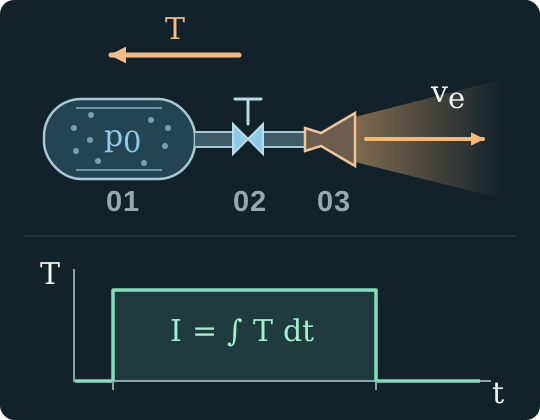
Pressure is stored. Momentum is released. Duration is spent.储存的是受压气体,释放的是动量,消耗的是可用时长。
The first term is momentum carried away per second: mass flow
NASA Glenn: the momentum and pressure terms in thrustNASA Glenn:推力中的动量项与压强项
Define an effective exhaust speed
Illustrative calculation: choose
As gas leaves, tank pressure and temperature change. Regulation can hold a working condition for part of the discharge; the supply remains finite. Cold gas therefore separates two timescales: energy can be invested while the supply is prepared, then released as a short burst of thrust. That makes peak performance and recovery time separate design targets. Neither the peak thrust nor the tank pressure alone tells us how many launches remain.排气时,罐内压力和温度会改变。调压可以在一段放气过程内维持工作条件,供给总量仍然有限。冷气系统把两个时间尺度分开:准备气源时投入能量,使用时以短促推力释放。于是峰值性能与恢复时间成为两个独立的设计目标。只知道峰值推力或储气压力,都算不出还可以再起步几次。
Work backwards from the launch target从加速目标反算受力条件
Now hold the car at one operating point on a level road. Combine the four tyres into one ideal contact model, neglect vertical acceleration and wheel-to-wheel load differences, and define upward thrust
Let
This approximation requires contact,
The distinction is geometric: suction enlarges the contact-force circle; a fixed forward jet shifts the total-force circle. A jet can add longitudinal force without spending the tyre’s friction allowance. That does not guarantee neutral handling: its height and position can also create pitch or yaw moments. Likewise, adding upward thrust while the car is still on the road reduces N and can remove some tyre traction before lift-off.开头图中的几何关系,现在可以从模型读出来:负压扩大接触力的圆,固定向前喷流平移整车合力的圆。喷流可以不占用轮胎的摩擦额度就增加纵向力,但其高度与位置仍可能产生俯仰或偏航力矩,影响操控。同样,车还在地面上时,增加向上推力会减小 N,在离地之前就可能先损失一部分轮胎抓地力。
A controller must therefore coordinate the systems around the current limit. Suction is useful when contact capacity is scarce and the power budget permits it. A forward jet is useful when extra longitudinal force justifies spending gas. Upward thrust changes the contact condition itself. Turning every actuator to its maximum is not a general solution; the useful command depends on speed, turn demand, wheel loads and remaining resources.控制系统因此要围绕当前瓶颈组织这些装置:接触力不足、功率预算又允许时,负压才有继续增加的价值;额外纵向力值得消耗储气时,再使用向前喷流;向上推力则会改变接触条件本身。每个执行器都开到最大,不构成通用解法;有用的指令取决于车速、转向需求、各轮载荷与剩余资源。
Which combinations can meet the one-second force threshold?哪些组合能达到一秒起步的受力门槛?
Apply the model to a straight launch: no cornering force or upward thrust, μ = 1, fixed mass and no resistance. Assume the motors can transmit all available grip throughout the run, and that suction and forward thrust remain constant. Write their magnitudes as fractions of vehicle weight:把模型用于直线起步:侧向力与向上推力为零,μ = 1,质量不变,忽略阻力。再假设电驱在整个过程都能用足抓地力,吸附力与向前推力保持恒定。用它们与车重的比值表示大小:
A full second from rest to 60 mph, with no rollout deducted, requires 26.8224 m/s of velocity change. With
For A, even constant maximum acceleration gives a best possible time of:对 A 而言,即使全程保持最大加速度,最快也只能达到:
This quantifies the shortfall identified at the start; it does not dispute a Tesla measurement. B and C close the same ideal force gap, with different hardware costs. At unchanged effective exhaust speed, B consumes more gas. C needs more tyre load and enough wheel force to use it; its fan-power cost depends on pressure, flow and efficiency. For time-varying operation, reaching 60 mph from rest in one second instead requires:这回答了开头示例为何不够,并非在否定某项 Tesla 实测。B 与 C 补上的是同一段理想力容量,硬件代价却不相同。在有效排气速度不变时,B 会多消耗气体。C 需要更大的轮胎载荷,也要有足够的轮端驱动力来利用它;风扇的功率代价取决于压差、流量与效率。若工况随时间变化,从静止起步并在一秒内达到 60 mph 应满足:
When more suction makes the car slower吸附力更大,加速度反而更小
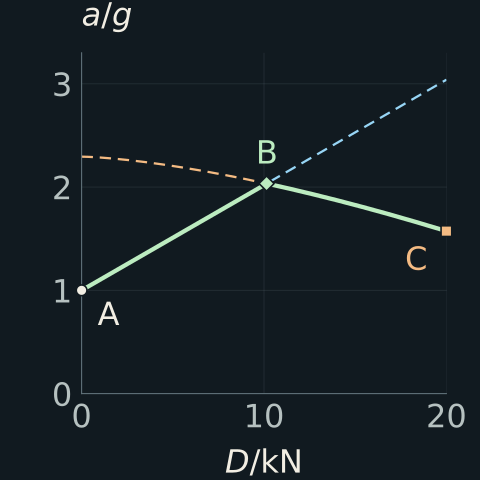
The previous chart treats grip as a capacity. To turn that capacity into acceleration, the motors still have to supply wheel force. Suppose a 1,000 kg car travels at 20 m/s, with its drive and suction fan sharing a 500 kW electrical power budget. Hold mass and speed fixed, use a friction coefficient of one, and omit jets and resistance. These are chosen parameters for a comparison at one operating point, not Tesla specifications or a simulation of the whole launch.上一张图算的是抓地力容量,要把容量用成加速度,电机仍需提供轮端驱动力。设一辆 1,000 kg 的车以 20 m/s 行驶,电驱与吸附风扇共用 500 kW 电功率。比较时固定质量与车速,摩擦系数取一,不计喷流与行驶阻力。这是一组用于比较单个工作点的自选参数,并非 Tesla 规格,也不是完整起步过程的仿真。
Assume a fixed underbody gap with leakage flow proportional to the square root of pressure difference. Suction grows with pressure, but the fan must move more air against that pressure, so its electrical draw grows faster. In the plotted range, the shared power budget sets the available drive force. Let
- Tyre limit / mg轮胎上限 / mg
- Drive force / mg可用驱动力 / mg
- Resulting acceleration / g实际加速度 / g
At first, suction converts unused drive capacity into acceleration: the tyres can transmit more of the force the motors could already supply. At the intersection, tyre capacity and available drive force match. Beyond it, stronger suction consumes electrical power that the motors need, so acceleration falls even as the tyre-force limit rises. The best suction setting therefore depends on speed, available power and leakage. A controller needs to choose that setting, not simply command maximum suction.起初,负压增加轮胎能传递的力,让电驱系统原本用不出去的能力变成加速度。到了交点,轮胎容量与可用驱动力恰好相等。再提高吸附力,风扇便会占用电机所需的电功率;轮胎上限继续升高,加速度却开始下降。因此,最佳吸附设定会随车速、可用功率与漏气状况改变。控制器要选择合适的工作点,不能只是把吸附力开到最大。
Model parameters and calculation模型参数与计算过程
All three points use the same installed hardware and mass. This is a quasi-steady, straight-line model with all available grip accessible to the driven wheels. Air density is constant, added duct losses are omitted, and fan control is assumed able to realize the selected pressure and flow. The leakage relation is a model of a fixed gap, not a universal fan characteristic.三个点使用相同的已安装硬件与整车质量。模型采用准稳态直线工况,并假设驱动轮可以利用全部附着能力。空气密度不变,不计额外管道损失,假定风扇控制可以实现所选压差与流量。漏气关系是固定间隙的简化模型,并非通用风扇特性。
- Mass · speed · gravity质量 · 车速 · 重力加速度
- 1,000 kg · 20 m/s · 9.80665 m/s²
- Friction coefficient · suction area摩擦系数 · 有效吸附面积
- μ = 1 · A = 4 m²
- Reference pressure · leakage flow参考压差 · 漏气流量
- Δp₀ = 2,500 Pa · Q₀ = 12 m³/s
- Fan · fan drive · traction drive efficiency风扇 · 风扇电驱 · 车辆电驱效率
- ηf = 0.60 · ηm = 0.90 · ηd = 0.90
- Electrical pool · wheel power rating共用电功率 · 轮端额定功率
- 500 kW · 450 kW
- Torque-limited wheel force轮端转矩对应的力上限
- 25 kN
Subtract the fan’s electrical draw from the electrical pool, then apply traction-drive efficiency to the remainder. Fan shaft power alone would underestimate the draw. Divide the resulting wheel power by the nonzero speed, and also enforce the 25 kN torque-force cap and 450 kW wheel rating; neither adds a tighter limit over this plot. At zero speed, use torque rather than dividing by speed.从电功率池中扣除风扇的电功率,再对剩余部分乘车辆电驱效率,得到轮端机械功率。只扣风扇轴功率会低估用电。轮端功率除以非零车速得到驱动力,还要检查 25 kN 转矩对应的力上限与 450 kW 轮端额定功率;在本图范围内,两者都不会进一步收紧限制。车速为零时应使用转矩约束,不能除以零车速。
U.S. Department of Energy: fan efficiency and electrical power accounting美国能源部:风扇效率与电功率计算
Hanging upside down and hovering are different force balances倒挂与腾空,必须分开解释
On the underside of a horizontal surface, suction pulls toward that surface while gravity still points down. For stationary contact, suction must balance both weight and the surface’s normal reaction. In free air, there is no road to supply support. Hovering or holding altitude then requires upward force to balance weight; a ballistic airborne arc can instead have less thrust than weight, or none. This change in the force balance is more important than whether a clip looks like “flying”.在水平顶面的下侧,负压作用力朝向顶面,重力仍然向下。静止贴附时,吸附力要平衡重量与顶面对车的法向反力。离开表面之后,路面不再提供支承。若要悬停或保持高度,需要向上力平衡重量;若沿弹道弧线运动,推力则可以小于重量,甚至为零。看懂这个受力条件的变化,才能判断画面中的“飞”具体意味着什么。
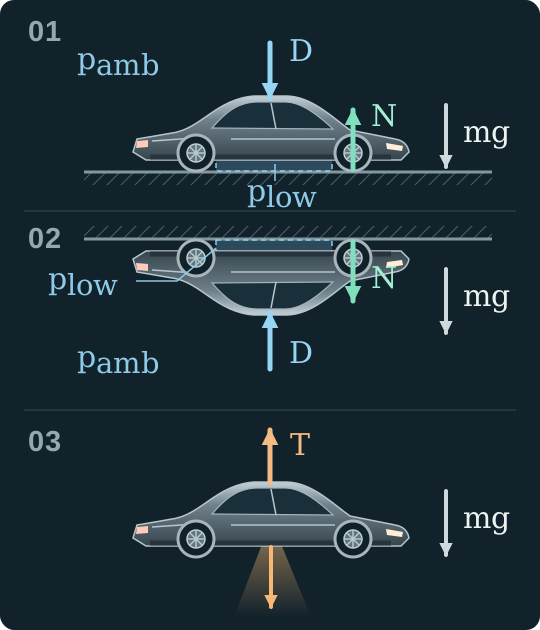
Contact, inverted contact, free air: support comes from a different balance in each case.正置、倒置、离地:每一种状态,都需要重新列出支承从哪里来。
The first equation contains a useful distinction: if suction only equals weight,
The second equation ignores other aerodynamic lift and takes upward as positive. Hovering requires total upward thrust equal to weight; upward acceleration requires more. Each tonne needs about 9.81 kN just to hover. With the previous illustrative exhaust speed, that would use about 19.6 kg/s per tonne before control margins. This is a scaling calculation, not an estimate of the demonstration car’s mass or flight duration.第二式忽略其他气动升力,并以向上为正。悬停要求总向上推力等于重量;要向上加速,还需更大推力。每吨质量仅维持悬停,就需要约 9.81 kN。沿用前面的示例排气速度,每吨每秒约消耗 19.6 kg 气体,尚未留出控制余量。这是比例计算,不是在推测演示车辆的质量或续航时间。
Fan suction near a sealed surface cannot simply be extrapolated into free-air lift. A fan can produce lift in free air if it accelerates enough air downwards, as a rotor or ducted fan does, but that is a different airflow problem. Tesla’s official ramp and kickflip clips are useful to compare the manoeuvres; neither clip alone is an endurance test.依靠附近表面与密封形成的负压,不能直接外推为空中升力。风扇若像旋翼或涵道风扇那样,把足够多的空气加速向下,也能在自由空气中产生升力,但那已是另一种流动条件。对照 Tesla 的坡道与翻滚官方短片,可以分清动作;单段视频并不能给出持续能力。
Tesla: The Ramp · Tesla: The KickflipTesla:坡道演示 · Tesla:空中翻滚演示
Starting or stopping an airborne roll requires torque. A thrust line that misses the centre of mass produces
NASA Glenn: off-centre forces and torqueNASA Glenn:偏心力与转动力矩
Consider a general example, not Tesla’s layout: two upward thrusters sit on opposite sides of the centre of mass. If both are already at maximum just to hover, reducing one creates a roll moment but also loses total lift. To roll while maintaining altitude requires thrust headroom or other actuators. The capacity to support weight and the capacity to control attitude have to be available at the same time.可以看一个通用例子,而非 Tesla 的实际布置:两只向上的推进器位于质心两侧。如果两只都要满推力才能勉强悬停,减小一侧推力虽然能启动翻滚,总升力却会下降。要在控制翻滚的同时保持高度,就需要推力余量,或者其他执行器。托住重量与控制姿态的能力,必须能在同一时刻兑现。
What does a one-second launch imply?一秒加速,究竟要求多大的力?
Tesla describes the Thrust package as capable of a sub-one-second launch. To understand the scale without treating a headline as a test report, consider a precisely defined hypothetical run: from rest to 60 mph in a full 1.000 s, with no rollout deducted. Sixty mph is 26.8224 m/s, or 96.56 km/h, not 100 km/h.Tesla 对 Thrust 配置给出了不到一秒的起步加速描述。要理解这个量级,可以先明确一组假设:真正从静止开始,完整计时 1.000 秒达到 60 mph,且不扣除 rollout。60 mph 等于 26.8224 m/s,即 96.56 km/h,并不等于 100 km/h。
Tesla: the Performance, Thrust and Rocket announcementTesla:Performance、Thrust 与 Rocket 配置公告
These values follow from
The small energy figure and large power figure are consistent: delivering about 0.100 kWh in one second requires about 360 kW. The launch problem is therefore not captured by battery capacity alone. Energy must be released fast enough, turned into useful force, and kept within tyre, thermal and structural limits. Each part of the car answers a different part of that requirement.0.100 kWh 看起来很小,360 kW 却很大,两者没有矛盾:把前者集中在一秒内交出去,就需要后者这样的功率量级。起步问题因此不能只看电池容量;能量要足够快地释放,转成有效受力,还要守住轮胎、温度与结构的限制。整车的不同装置,各自解决其中一部分。
Now change only the timing rule. One-foot rollout excludes the first foot of travel from the recorded time. The car is already moving when that clock starts, so dividing the full 60 mph by the reported time no longer gives the average acceleration from rest. Before comparing two results, align the target speed, rollout, slope, surface, tyres, load and instrumentation.再只改变计时规则。One-foot rollout 会把最初一英尺的行程排除在记录时间之外。计时开始时,车已经在移动;这时再用完整的 60 mph 除以公布时间,就不再是从静止起步的平均加速度。比较两个成绩前,需要对齐终点速度、rollout、坡度、路面、轮胎、载荷与测量设备。
Racelogic: what one-foot rollout removes from a timing resultRacelogic:one-foot rollout 从计时中扣除了什么
Make the hardware earn its mass让增加的硬件,挣回自己的重量
Every added vessel, valve, fan and reinforcement travels with the car even when it is inactive. To test whether the package improves acceleration, compare the same operating point before and after adding it. Let the original mass and net forward force be
For the acceleration to improve,
At an illustrative operating point with acceleration 26.82 m/s², an extra 100 kg must deliver more than 2.68 kN of additional net force just to improve that acceleration.
A brief launch and sustained high speed stress different parts of the system. At low speed, traction and available thrust can dominate. As speed rises, delivering the same drive force takes more mechanical power,
Doubling speed then quadruples aerodynamic drag and multiplies the power needed to overcome it by eight. Real active aerodynamics can change
NASA Glenn: the drag equationNASA Glenn:空气阻力公式
OpenStax: mechanical power and work rateOpenStax:机械功率与做功速率
The useful next test is a sequence, not just a single best launch. Record successive accelerations under stated conditions, along with the time needed to recover performance. That exposes whether a spectacular peak remains available when the driver asks for it again. Four measurements would connect the demonstration to an engineering assessment:下一步最有信息量的测试,是一组连续过程:在明确条件下记录多次加速,再记录恢复性能需要的时间。这样才能看出,驾驶者再次提出同样要求时,那个惊人的峰值是否仍然可用。以下四组测量,可以把演示与工程评估接起来:
- Repeatability: several launches with stated intervals, recording battery temperature, charge state and remaining gas.重复性:明确间隔,连续起步,记录电池温度、荷电状态与剩余气量。
- Pressure retention: downforce, fan power and response as ground clearance and surface conditions change.压差保持:离地间隙、路面条件改变时,下压力、风扇功率与响应怎样变化。
- Impulse and recovery: thrust versus time, gas used per manoeuvre, and the time and energy needed to restore readiness.冲量与恢复:推力时间曲线、单次耗气量,以及恢复可用状态所需的时间和能量。
- Control envelope: vehicle mass and load distribution, available lift and torque, and the conditions under which the demonstrated manoeuvre remains controllable.控制范围:整车质量、载荷分布、可用升力与力矩,以及演示动作在什么条件下仍可控。
Read this way, the Roadster raises a design question larger than its launch time: how much of a car’s available force can become something its controller actively shapes? Motor torque selects a demand within the tyre limit; suction changes that limit; jets contribute force beyond the tyre contact. Together they offer more ways to respond to the driver, but also more conditions under which the response can change.沿着这条线看,Roadster 提出的设计问题比起步成绩更大:一辆车可用的受力范围,有多少能够由控制系统主动塑造?电机转矩在轮胎限制内提出需求,负压改变这条限制,喷流在接触力之外增加贡献。三者让车辆拥有更多响应驾驶者的方式,也带来更多会改变响应能力的条件。
The strongest demonstration of this architecture would be a car that knows the force it can still deliver, allocates it between acceleration, steering and attitude control, and reduces its demands coherently as grip, gas or thermal margin falls. Peak force makes the manoeuvre possible. Predictable force, available at the right instant and repeatable under stated conditions, is what would make the combination a convincing vehicle.最能证明这套架构价值的,是车辆知道自己此刻还能给出多少力,能够协调加速、转向与姿态控制,并在附着、储气或温度余量下降时,有序地收回超出能力的需求。峰值受力让动作成为可能;在正确时刻提供可预期的响应,并在明确条件下再次实现,才会让这些装置真正组成一辆令人信服的车。