Specify the whole second先把这一秒定义完整
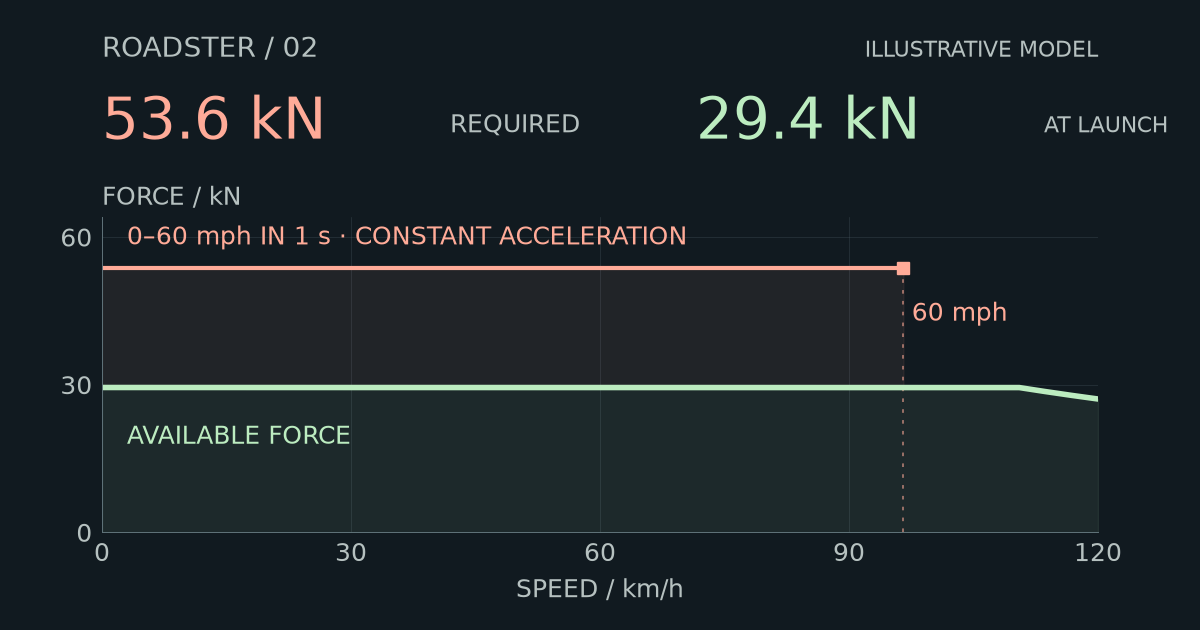
Ask for one precise contribution: an extra 10 kN of forward thrust for one second. This requires 10 kN·s of impulse. On a 2,000 kg vehicle, ignoring added hardware, changing mass and other forces, that impulse contributes about 5 m/s of velocity. It does not by itself establish a one-second 0–60 mph time. The missing quantity in a peak-thrust claim is how long the force remains available.把任务限定清楚:在一秒内,持续向车身额外提供 10 kN 向前推力。这需要 10 kN·s 的冲量。对一辆 2,000 kg 的车,暂不计新增硬件、质量变化与其他受力,这份冲量约能贡献 5 m/s 的速度增量;它本身不能证明一秒完成 0–60 mph。峰值推力之外,还缺一项决定性的条件:这股力能维持多久。
The tyres in Part 3 exchange momentum with the road. A cold-gas jet exchanges momentum with expelled gas, so it can add force without asking the tyre contact patches to transmit that force. Tesla’s Roadster page describes cold-gas thrusters; the pressures, volumes and nozzle dimensions below are our explicit engineering assumptions, not disclosed vehicle specifications or measured performance.在第三期中,轮胎与地面交换动量;冷气喷流则与排出的气体交换动量,增加的这股力不必经过轮胎接触区传递。Tesla 的 Roadster 页面已经描述冷气推进器,但下面的罐压、容积和喷嘴尺寸都是本期明确给定的工程假设,并非已披露的整车规格或实测性能。
One force, three different jobs一股推力,三段不同的任务
100 L · initially 300 K100 L · 初始 300 K
Ideal regulator + valve理想稳压器与阀门
Gas moves right; vehicle force left气流向右,车身受力向左
Start with momentum; keep the pressure term从动量守恒开始,把压力项留下
A cold-gas system does not burn fuel in the nozzle. Compressed gas accelerates as it expands: its enthalpy supplies the jet’s kinetic energy. In a control volume around a quasi-steady nozzle, the outgoing momentum flux produces one part of the reaction force. If exit pressure exceeds ambient pressure, the pressure difference supplies another. NASA’s thrust balance keeps both terms.冷气系统不在喷嘴中燃烧燃料。压缩气体在膨胀中加速,气体的焓转化为喷流动能。对一个准稳态喷嘴写控制体的动量平衡,流出动量产生一部分反作用力;出口压力若高于环境压力,压差还会贡献另一部分。NASA 的推力方程保留了这两项。
Here ṁ is the discharged mass per second, vₑ the exit speed relative to the nozzle, Aₑ the exit area, and pₑ and pₐ the exit and ambient pressures. The energy balance of an adiabatic nozzle, with negligible inlet speed, is cₚT₀ = cₚTₑ + vₑ²/2. T₀ is the inlet stagnation temperature, Tₑ the exit static temperature, and cₚ the specific heat at constant pressure. Lower temperature means less energy available per kilogram to turn into jet speed.这里 ṁ 是每秒排出的质量,vₑ 是相对喷嘴的出口速度,Aₑ 是出口面积,pₑ 与 pₐ 分别为出口和环境压力。对入口速度可忽略的绝热喷嘴,能量平衡为 cₚT₀ = cₚTₑ + vₑ²/2。T₀ 是入口总温,Tₑ 是出口静温,cₚ 是定压比热。温度降低,意味着每千克气体能转化为喷流速度的能量减少。
For the chosen converging nozzle, the initial momentum term is 5.99 kN and the pressure term 4.01 kN. Omitting exit pressure would lose about 40% of this example’s thrust. Define effective exhaust speed ceff = F/ṁ to combine both contributions: initially it is 529 m/s, so a quick estimate for 10 kN·s is 18.9 kg of gas. That estimate will be too optimistic once the tank cools.本例收敛喷嘴的初始动量项为 5.99 kN,压力项为 4.01 kN,删去出口压力会漏掉约 40% 的推力。用有效排气速度 ceff = F/ṁ 把两者合在一起,初始得到 529 m/s。由此粗估,10 kN·s 需要 18.9 kg 气体;等储罐开始降温,这个估计就会偏乐观。
Choose the nozzle and supply together喷嘴和供气,必须一起选
Use dry ideal air with specific gas constant R = 287 J/(kg·K) and γ = cₚ/cᵥ = 1.4, initially at 300 K in a rigid 100 L tank at 30 MPa. Ambient pressure is 101,325 Pa. The tank contains 34.84 kg in this ideal-gas model. Compare two architectures with the same tank and the same initial 10 kN thrust: a small fixed nozzle fed directly by the tank, and a larger fixed nozzle fed through an ideal 3 MPa regulator.取干燥理想空气,比气体常数 R = 287 J/(kg·K)、γ = cₚ/cᵥ = 1.4;刚性储罐内部容积 100 L,初始压力 30 MPa、温度 300 K,环境压力 101,325 Pa。按理想气体模型,初始储气 34.84 kg。比较两条储罐相同、初始推力都为 10 kN的路径:小孔径固定喷嘴直接接储罐,以及较大孔径固定喷嘴配理想 3 MPa 稳压供气。
Both nozzles are purely converging, with the throat also serving as the exit. Flow becomes choked when the throat reaches the local speed of sound. For γ = 1.4, this requires ambient pressure below 0.528 of inlet stagnation pressure. Our calculated interval satisfies that condition. Choking fixes the maximum flow for a given area and inlet state; it does not make that flow independent of tank pressure.两个喷嘴都采用纯收敛形状,最窄的喉部同时就是出口。喉部流速达到当地声速时发生堵塞流动。γ = 1.4 时,这要求环境压力低于入口总压的 0.528 倍;本期计算区间满足这个条件。堵塞限制的是给定面积和入口状态下的最大流量,并不意味着流量从此不受供压影响。
Let p₀ denote nozzle inlet stagnation pressure, which is different from tank pressure after regulation. Set χ = [2/(γ + 1)]γ/(γ − 1). At the sonic exit, pₑ = χp₀, Aₑ = Aₜ and ṁvₑ = γpₑAₜ, giving:用 p₀ 表示喷嘴入口总压;经过稳压后,它与罐压不同。令 χ = [2/(γ + 1)]γ/(γ − 1)。声速出口处 pₑ = χp₀、Aₑ = Aₜ,且 ṁvₑ = γpₑAₜ,于是:
At 3 MPa, producing 10 kN requires an ideal throat area of 27.01 cm², equivalent to one circular throat 58.6 mm across. Direct feed at 30 MPa needs only 18.3 mm. These are two separately sized nozzles, not a comparison made by inserting a regulator upstream of an unchanged nozzle. The direct-feed nozzle loses thrust as tank pressure falls; the regulated nozzle trades a larger flow passage for a flatter force history.在 3 MPa 下产生 10 kN,需要理想喉部面积 27.01 cm²,相当于一个直径 58.6 mm 的圆孔;30 MPa 直接供气则只需 18.3 mm。这里分别匹配了两个喷嘴,并不是在同一个喷嘴前简单加装稳压器。直接供气会随罐压下降而失去推力;稳压方案则以更大的流通截面,换取更平坦的受力过程。


Direct feed crosses 8 kN after only 0.305 s. Ideal regulation holds 10 kN for 1.322 s. Counting both designs to the same 3 MPa tank cutoff, direct feed delivers 13.49 kN·s and regulation 13.22 kN·s. Regulation does not create extra impulse: it changes when useful force is delivered. A valve-opening photograph or a single peak reading would miss this difference. For a one-second assist, the relevant result is the complete thrust trace and its integral, together with the time at which the required force becomes unavailable.直接供气只过 0.305 s 就降到 8 kN;理想稳压可以把 10 kN 保持 1.322 s。如果两者都算到罐压 3 MPa,直接供气累计交付 13.49 kN·s,稳压为 13.22 kN·s。稳压没有凭空增加冲量,而是改变有用的力在什么时段交付。一次喷气画面或单个峰值读数看不出这个差别。对一秒辅助推进,应该验收完整推力曲线及其积分,并记录所需推力从哪个时刻开始无法交付。
The choked-flow calculation堵塞流量怎样计算
With an ideal isentropic nozzle and discharge coefficient one, NASA’s choked-flow relation gives the following. Aₜ is throat area and T₀ the nozzle inlet stagnation temperature. The square-root dependence is the reason cooling changes gas consumption even under constant supply pressure.理想等熵喷嘴、流量系数取 1 时,NASA 的堵塞流量关系如下。Aₜ 为喉部面积,T₀ 为喷嘴入口总温。正是这里的平方根关系,使得供压恒定时,冷却依然改变耗气速度。
A converging–diverging nozzle can expand the gas further before it exits. Ideal expansion from 3 MPa and 300 K to ambient would give about 611 m/s, rather than this converging nozzle’s initial effective 529 m/s. That alternative requires a different geometry and off-design analysis. The chosen nozzle is a transparent comparison, not an upper performance limit for cold-gas propulsion.收敛—扩张喷嘴可以让气体在出口之前继续膨胀。若从 3 MPa、300 K 理想膨胀到环境压力,可得到约 611 m/s,而本例收敛喷嘴初始有效排气速度为 529 m/s。前者需要另一套几何与偏离设计点的分析。本例用于清楚比较供气路径,不代表冷气推进的性能上限。
Constant thrust still empties a cooling tank推力不变,储罐仍在降温
The tank wall does not move, but gas and energy leave it. Write the balance for a well-mixed, rigid, adiabatic tank: its internal energy is mcᵥT, where cᵥ is the specific heat at constant volume, while each kilogram leaving carries enthalpy cₚT. Let m be the gas remaining and ṁ > 0 the outflow. There is no wall work or heat transfer in this baseline.罐壁没有移动,气体和能量却不断流出。对充分混合、刚性、绝热的储罐写能量平衡:罐内内能为 mcᵥT,cᵥ 是定容比热,每千克流出的气体则带走焓 cₚT。m 表示剩余气体质量,ṁ > 0 表示流出量;基准模型中没有罐壁做功,也没有外界传热。
Expanding the derivative and using cₚ − cᵥ = R gives dT/T = (γ − 1)dm/m. Combining that result with pV = mRT yields two useful ratios, with subscript i marking the initial state. This is an open-system balance; applying the closed-gas formula pVγ = constant to a tank whose gas mass is changing would be the wrong shortcut.展开导数,利用 cₚ − cᵥ = R,得到 dT/T = (γ − 1)dm/m;再与 pV = mRT 联立,就得到下面两个比例,角标 i 表示初始状态。这是开放系统的能量平衡:罐内质量在变,不能把密闭气体的 pVγ = 常数直接套在恒容储罐上。
An ideal adiabatic regulator throttles without changing enthalpy; for our ideal gas, its outlet stagnation temperature follows the tank temperature. While p₀ stays at 3 MPa, cooling makes ṁ rise as 1/√T and vₑ fall as √T. Their product stays constant, as does the exit pressure contribution. The force remains 10 kN while gas consumption rises from 18.9 to 26.3 kg/s.理想绝热稳压阀按等焓节流处理;对本例理想气体,阀后总温跟随罐温下降。p₀ 保持 3 MPa 时,冷却使 ṁ 按 1/√T 增加,vₑ 按 √T 降低,乘积保持不变,出口压力项也不变。因此推力仍是 10 kN,耗气却从 18.9 kg/s 增至 26.3 kg/s。


After the first second in the 100 L tank, 20.36 kg has been used and 8.78 MPa remains. At p = 3 MPa, this model has delivered 13.22 kN·s using 28.12 kg of gas. Its mean effective exhaust speed over that burst is about 470 m/s, below the initial 529 m/s. The useful operating interval ends before all 34.84 kg has been expelled. The Stanford tank-blowdown exercise develops the same distinction between thermal assumptions and asks for pressure/temperature measurements to test them.100 L 储罐在第一秒结束时,已经用掉 20.36 kg 气体,罐压还剩 8.78 MPa。罐压到 3 MPa 时,模型已用掉 28.12 kg 气体,交付 13.22 kN·s 冲量;这一段的平均有效排气速度约 470 m/s,低于初始的 529 m/s。可用工况结束时,34.84 kg 初始气体并没有全部排出。Stanford 的储罐放空练习也区分不同传热假设,并要求通过压力与温度测量来检验模型。
The calculated 155 K endpoint is a model result, not a claimed hardware temperature. At 30 MPa and during such cooling, real-gas properties, changing specific heats and wall heat transfer matter. A real regulator also needs a pressure margin and may lose outlet pressure as flow rises; Swagelok’s regulator flow-curve guide explains these flow-dependent limits. The 1.322 s plateau assumes zero supply-line losses and perfect regulation right down to 3 MPa; actual sizing requires property data and measured component maps.155 K 的终点是模型结果,不是对真实硬件温度的宣称。30 MPa 储气与显著降温过程,需要考虑真实气体物性、变比热及罐壁换热。真实稳压器还需要压差余量,流量增大也可能使出口压力下降;Swagelok 的稳压器流量曲线指南解释了这些随流量改变的限制。1.322 s 的平台假定管路无压损,且能一直理想稳压到罐压恰好 3 MPa;实际选型必须补上物性数据和部件实测曲线。
Size storage from duration, not peak force先定持续时间,再反推储气空间
For fixed initial pressure, temperature and nozzle supply pressure, the regulated nozzle determines the consumption rate while tank volume determines the initial inventory. The resulting plateau duration scales linearly with volume. Under the adiabatic assumptions above, one second at 10 kN needs approximately 75.6 L of internal tank volume; two seconds need 151 L. Wall thickness, mounts, valves and clearances occupy additional space.初始压力、温度和喷嘴供压固定后,稳压喷嘴决定耗气速率,储罐容积决定初始存量,因此推力平台时长与容积成正比。在前述绝热假设下,10 kN 持续一秒约需 75.6 L 储罐内部容积,两秒约需 151 L;罐壁、支架、阀组和安装间隙还要占用额外空间。


Increasing throat area delivers force faster and spends gas faster. Raising storage pressure puts more gas in a given volume, but also changes vessel stress, material requirements and real-gas behaviour. Neither change removes the need to carry the gas and its containment. For this one-second task, a stable supply path and its flow capacity should be settled before chasing a larger peak.加大喉部会更快交付推力,也更快消耗气体;提高储气压力能在同一容积里装入更多气体,但也改变容器应力、材料要求与真实气体行为。两种改动都没有消除气体及其容器的携带代价。对这一秒的任务,应先确定稳定供气路径及其流量能力,再追求更高峰值。
Temperature recovery between pulses complicates repeated use. Gas warming against the vessel wall can make the gauge pressure rise without adding a single kilogram. The second pulse therefore needs the remaining mass and temperature, not just the pressure reading or an assumed repeat of the first pulse.多次使用还受脉冲间回温影响:气体从罐壁吸热后,即使一千克气体也没补进去,压力表也会回升。因此第二次脉冲需要知道剩余质量和温度,不能只看表压,更不能直接照搬第一次的推力曲线。
Refilling takes more than a pressure recovery压力回升,还没有完成补气
Consider refilling after the complete 1.322 s regulated burst. The remaining 6.73 kg is initially at 155 K and 3 MPa. Once it warms to 300 K in the sealed tank, pressure reaches 5.79 MPa. We must start the refill calculation there, not at the cold 3 MPa state.考察完整 1.322 s 稳压脉冲之后的补气。剩余 6.73 kg 气体初始处于 155 K、3 MPa;封闭回温到 300 K 后,压力达到 5.79 MPa。补气的计算应从这个状态开始,不能继续拿冷态 3 MPa 当起点。
A best-case compressor draws air from ambient and delivers each small increment at the tank’s current pressure. Reversible isothermal compression at 300 K requires RT ln(p/pₐ) joules per kilogram. The tank is also held at 300 K throughout filling, with heat continuously removed. With p = mRT/V in the tank, integrate from the warmed residual pressure pw to the initial fill pressure pᵢ:设一台理想压缩机从环境吸气,每增加一小份气体,都按当时罐压供气。在 300 K 可逆等温压缩下,每千克所需功为 RT ln(p/pₐ)。充气全过程也将储罐维持在 300 K,并持续排走热量。再用罐内 p = mRT/V 换元,从回温后的剩余压力 pw 积分到初始充气压力 pᵢ:
For this refill, the result is 12.31 MJ, or 3.42 kWh. Even if a 5 kW input were converted entirely into that reversible compression work, it would take about 41 minutes, after the assumed return to 300 K. Real electrical consumption and elapsed time include losses and thermal limits. This is a lower bound for the specified atmospheric-air refill process, not a Roadster charging specification.本次补气得到 12.31 MJ,即 3.42 kWh。即使把 5 kW 输入全部用于这份可逆压缩功,在已经回温到 300 K 的前提下,仍需约 41 分钟。真实电耗与耗时还包含损失和热约束。这是指定环境吸气、补回原状态过程的理想下限,不是 Roadster 的充气规格。
The engineering consequence is a duty-cycle constraint: the car can spend compressed-gas energy in a second and require much longer to restore it. An external reservoir can move the waiting time away from the car, but still needs its own pressure, inventory and compression-energy budget. Part 6 will join this recovery process to the drivetrain’s thermal cycle.由此得到一项使用周期约束:车可以在一秒内花掉压缩气体的可用能量,却要花更久恢复它。外置气源可以把等待转移到车外,但仍需要独立计算供压、储量与压缩能耗。第六期再将这段恢复过程与电驱系统的热循环合并。
Subtract the hardware before claiming the gain把装车代价从收益里扣掉
Carry the 26.8224 m/s² target acceleration from Part 2. Suppose the vessels, valves, lines and mounts add 100 kg of dry mass; this is a sensitivity assumption, not a weight estimate. Add the initial 34.84 kg of gas. At the same requested acceleration and road resistance, the extra mass demands 3.62 kN, leaving 6.38 kN of the jet’s 10 kN to reduce the wheel-force requirement at the start of the burst.沿用第二期的 26.8224 m/s² 目标加速度。假设容器、阀门、管路与支架增加 100 kg 干重——这只是敏感性假设,不是重量估计——再加上初始 34.84 kg 气体。在相同目标加速度与道路阻力下,额外质量需要 3.62 kN,因此喷流的 10 kN 在脉冲开始时,只有 6.38 kN 用于减轻轮端力需求。
As gas leaves, the inertial penalty falls, but hardware remains. Here ΔFwheel,relief is the reduction in wheel-force demand: baseline minus the demand with the jet system installed. This is a force comparison at a prescribed acceleration, not a simulated launch time. Packaging and force direction matter as well: a 10 kN force with a 0.6 m lateral offset produces 6 kN·m of yaw moment. Cancelling that moment can spend tyre-force reserve. Part 5 will turn those coupled demands into a force-allocation problem.气体排出后,额外惯性需求会减小,硬件质量却一直留在车上。这里 ΔFwheel,relief 表示轮端力需求的减少量,即原始需求减去装上喷气系统后的需求。这是给定加速度下的受力比较,不是整车加速时间仿真。布置与方向同样重要:10 kN 推力的作用线若横向偏离质心 0.6 m,就会产生 6 kN·m 偏航力矩;抵消它可能消耗轮胎受力余量。第五期再把这些耦合需求写成受力分配问题。
Test the useful interval, not the peak验收可用区间,不只记录峰值
For a one-second auxiliary push, the first design question is whether the complete supply path can maintain the required nozzle pressure while consumption rises. Direct feed is simpler but accepts a decaying force; regulation holds a more useful plateau at the cost of flow capacity, additional components and pressure margin. A different nozzle expansion ratio may improve gas efficiency, but it must be compared with the same storage and installed-mass budget.对一秒辅助推进,首先要解决的是整条供气路径能否在耗气不断上升时,维持所需喷嘴入口压力。直接供气较简单,但必须接受推力衰减;稳压能保持更有用的平台,代价是更大的流量能力、额外部件与压差余量。换用更充分膨胀的喷嘴也许能提高气体利用效率,但必须放在相同储气与装车质量预算下比较。
| Decision决策 | Measure测量 | Acceptance question判断 |
|---|---|---|
| Supply capacity供气能力 | Measure测量Tank and plenum pressures, mass flow, valve command and temperature across the burst.同步记录罐压、喷嘴前压力、质量流量、阀门指令与温度。 | Acceptance question判断Does the real regulator still hold the required pressure near the cold, high-flow end?接近低温、高流量终点时,真实稳压器还能否维持所需压力? |
| Delivered impulse交付冲量 | Measure测量Measured force versus time, opening/closing delay and force direction; integrate the trace.测量推力时序、启闭延迟及力的方向,并对曲线积分。 | Acceptance question判断Does the force stay above the mission requirement for its full duration, including transitions?把启闭过渡也算进去,推力是否在整个目标时段满足要求? |
| Ready for another pulse下一次能否使用 | Measure测量Gas mass and temperature after rest, refill electrical energy, elapsed time and installed dry mass.记录静置后的气体质量与温度、补气电耗和耗时,以及系统装车干重。 | Acceptance question判断Can the next burst repeat the useful interval within the actual mass and recovery budget?在真实质量和恢复时间预算下,下一次是否还能重复可用推力区间? |
The model answers the opening question conditionally: an ideal 100 L / 30 MPa supply with a matched regulated nozzle can sustain the requested second; an equally powerful initial direct-feed nozzle does not hold its peak. The decisive result is the usable thrust history after accounting for cooling, supply limits and carried mass. A high initial pressure alone does not establish that result.回到开头的问题:按本文理想假设,100 L、30 MPa 储气配合匹配的稳压喷嘴,能够覆盖所需的一秒;初始同样有力的直接供气喷嘴,却维持不住峰值。真正决定方案的是扣除冷却、供气限制与携带质量之后的可用推力时序,单独一个很高的初始压力无法证明这一点。
The parameters and calculation results accompany the figures. The tank model is checked against independent mass-and-energy integration and limiting thermal cases. The measurements above have not been performed; real-gas properties, regulator maps, losses, structural qualification and vehicle dynamics remain outside these calculations.参数与计算结果随图提供。储罐模型通过独立的质量—能量积分与传热极限工况核对;表中的实物测量尚未执行。真实气体物性、稳压器曲线、流路损失、结构验证与整车动力学仍在本期计算之外。