Problem definition and principal results问题定义与主要结果
This installment analyses how to allocate cold-gas thrust and left/right tyre forces while meeting a specified yaw-moment demand. The calculation starts with a fixed planar operating state, then examines compensation delay and a loss of tyre-force capacity. The quantities of interest are the available forward force, the remaining yaw-moment authority in each direction and the motion caused by a temporary force imbalance.本期分析冷气推力与左右轮胎力的协同分配:在满足偏航力矩要求的条件下,确定可用纵向力。先计算一个固定的平面工况,再分析补偿延迟和轮胎能力下降。重点考察三个量:纵向力上限、两个方向的偏航力矩余量,以及短时受力失衡引起的运动响应。
Tesla’s public Roadster page describes cold-gas thrust for acceleration and attitude adjustment. It does not provide the allocation matrix, actuator delays or fault-response logic required for this analysis. The following model uses stated assumptions; its results describe those assumptions, not measured Roadster performance or Tesla’s control implementation.Tesla 的 Roadster 官方页面介绍了冷气推力用于加速与姿态调整,但没有给出本分析需要的分配矩阵、执行器延迟和故障处理逻辑。下文采用明确的模型假设,计算结果只适用于这些条件,不代表 Roadster 实测性能或 Tesla 的控制实现。
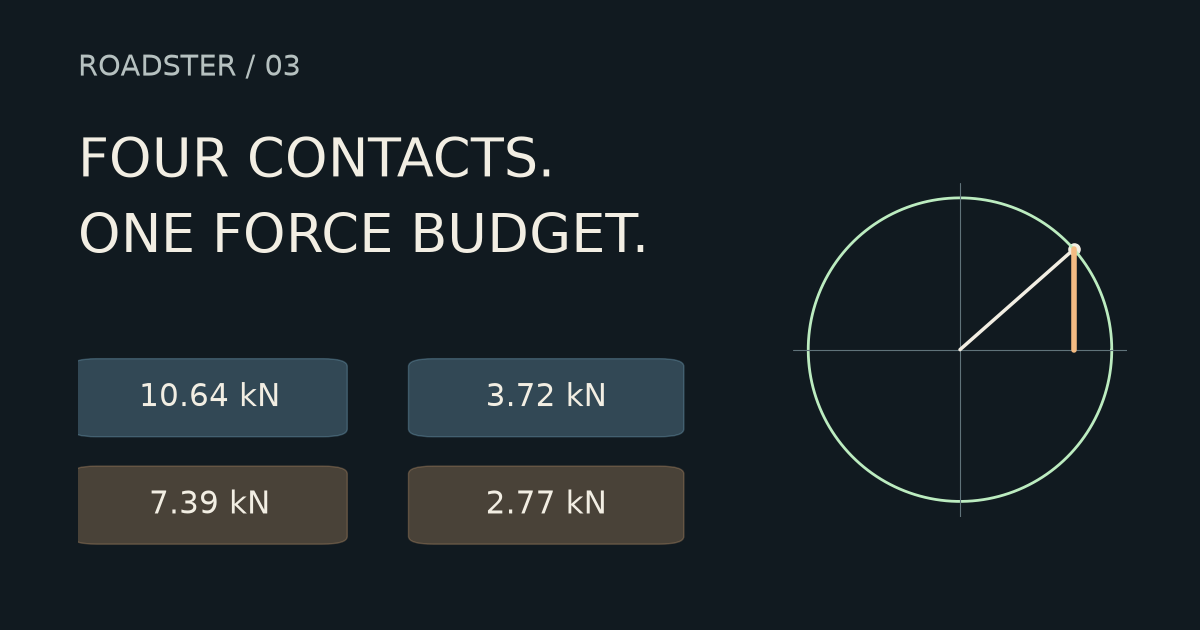
Principal result: with 12 kN of longitudinal capacity per side, a 1.6 m track and 10 kN of forward thrust offset 0.6 m to the left, the zero-yaw-moment forward-force limit is 26.5 kN. The same installed vehicle produces 24 kN with the jet off, or 34 kN if that thrust acts on the centreline. In this model, reducing the thrust offset substantially increases the forward-force limit.主要结果:每侧可用纵向力为 12 kN、轮距为 1.6 m、向前喷气力为 10 kN、作用线偏置于质心左侧 0.6 m 时,零偏航力矩下的纵向力上限为 26.5 kN。同一辆装好系统的车,关闭喷流时为 24 kN;将同等推力移到中心线时为 34 kN。对本模型而言,减小推力偏置能显著提高纵向力上限。
Planar force and moment balance平面受力与力矩平衡
Use axes fixed to the car: x forward, y left and z up. For a level planar model with constant yaw inertia, the net external force accelerates the centre of mass, while the net yaw moment changes yaw rate. Here aₓ and aᵧ are inertial accelerations resolved along the car’s axes; r is yaw rate, in radians per second.采用随车坐标:x 向前,y 向左,z 向上。在车身保持水平、偏航转动惯量固定的平面模型中,外力合力改变质心运动,偏航合力矩改变绕竖直轴旋转的角速度。这里 aₓ、aᵧ 是惯性加速度沿车身坐标的分量,r 是偏航角速度,单位为弧度每秒。
The last equation gives the yaw moment of each force about the centre of mass. A forward jet on the left contributes negative yaw moment; a larger forward tyre force on the right contributes positive yaw moment. The allocator must therefore satisfy forward force, lateral force and yaw moment together. Road resistance must also be included when converting a specified acceleration into actuator-force demand.最后一式给出各作用力相对质心产生的偏航力矩。左侧向前的喷气力产生负偏航力矩,右侧增大的向前轮胎力产生正偏航力矩。因此,分配器需要同时满足纵向力、横向力与偏航力矩要求。从目标加速度反算执行器需求时,还应计入道路阻力。
Suction changes normal loads and hence the forces the tyre contact patches can transmit. It does not directly add forward force. Pitch and roll redistribute wheel loads; ride height affects sealing; loss of contact removes the corresponding road force. These states are required in a full vehicle model, even though the present calculation freezes them. Part 3 covers wheel loads and Part 4 covers gas supply.吸附改变法向载荷,进而改变轮胎接触区能够传递的力,不直接增加纵向力。俯仰和侧倾改变轮载分配,离地间隙影响密封,车轮离地则失去对应的地面作用力。完整整车模型需要处理这些状态;本次计算先将它们固定。轮载分析见第三期,供气能力见第四期。
Longitudinal force under yaw balance偏航平衡约束下的纵向力
Assume each side’s two tyres have a combined longitudinal capacity C = 12 kN after satisfying a prescribed lateral-force demand. Denote their combined forces by L and R, with a track of 1.6 m. A forward jet supplies T = 10 kN at a leftward offset d = 0.6 m. Hold the lateral-force allocation fixed, with zero net yaw moment from those lateral forces. Require zero total yaw moment and omit road resistance from this force comparison.设每侧两个轮胎在满足给定横向力需求后,合计剩余纵向力上限为 C = 12 kN。左、右侧合力分别记为 L、R,轮距取 1.6 m。喷流提供 T = 10 kN 向前推力,作用线位于质心左侧 d = 0.6 m。横向力分配保持不变,其偏航合力矩为零;要求总偏航力矩也为零。本次受力对照不计道路阻力。
The capacities are assumed, not measured. The model allows independent left/right force selection; an actual motor/differential layout and compatible tyre-slip states may restrict those choices. Loads and capacities remain fixed, with no additional yaw correction through lateral tyre forces. The result is a limit for this allocation model. All comparisons retain the same installed vehicle mass, including jet hardware when the jet is off.上述能力上限为假设值,并非实测值。模型允许独立选择左右力;真实电机与差速器结构、相容的轮胎滑移状态可能进一步限制可选组合。轮载与能力上限保持固定,也不通过改变横向轮胎力额外纠偏。因此,计算给出的是本分配模型的上限。各对照采用相同的装车质量,关闭喷流时仍包含喷气硬件。

The jet contributes −6 kN·m of yaw moment. Cancelling it requires R − L = dT/b = 7.5 kN. Forward force is maximised when R reaches its 12 kN limit; the balance then requires L = 4.5 kN. The total is 12 + 4.5 + 10 = 26.5 kN. With the jet off, L = R = 12 kN gives 24 kN. The jet therefore increases forward force by 2.5 kN. Relative to the jet-off case, 7.5 kN of left-side drive force must be removed to maintain yaw balance; this reduction is not a nozzle-efficiency loss.喷流产生 −6 kN·m 偏航力矩。抵消该力矩,要求 R − L = dT/b = 7.5 kN。纵向力最大时,R 达到 12 kN 上限,力矩平衡相应要求 L = 4.5 kN,合计 12 + 4.5 + 10 = 26.5 kN。关闭喷流时,L = R = 12 kN,合计 24 kN。因此,开启喷流后的纵向力净增量为 2.5 kN。相对关闭喷流的工况,左侧驱动力必须减少 7.5 kN,才能维持偏航平衡;这项减量不属于喷嘴效率损失。


With the thrust line through the centre of mass, the jet produces no yaw moment and the limit becomes 12 + 12 + 10 = 34 kN. A symmetric pair also cancels nominal yaw moment when both jets deliver equal thrust. This compares equal total thrust at different geometries; hardware cost, packaging, additional mass and one-sided failure still require separate assessment. The formula assumes d ≥ 0 and a feasible left/right force difference. The forward-only operating points shown also require dT/b ≤ C.推力作用线穿过质心时,喷流不产生偏航力矩,上限为 12 + 12 + 10 = 34 kN。对称布置的一对喷口,在两侧推力相等时也能抵消偏航力矩。这里比较的是等总推力下的不同几何布置;硬件成本、安装空间、新增质量和单侧失效仍需分别评估。上式假定 d ≥ 0,且所需左右差动力可实现。图中全部向前驱动的工况还要求 dT/b ≤ C。
Feasible set and directional yaw reserve可行域与方向性偏航余量
The feasible set contains all forward-force and yaw-moment combinations that the actuators can produce simultaneously. For this calculation, allow signed side forces −C ≤ L, R ≤ C, where negative force means braking. Equal drive and brake limits are an idealised relaxation. Keep jet thrust fixed at 10 kN and map every admissible pair (L, R) through the balance equations. A target outside the resulting region has no solution within this model.可行域表示执行器能够同时产生的全部纵向力与偏航力矩组合。本节允许左右侧力在 −C ≤ L, R ≤ C 内变化,负值表示制动;驱动与制动上限相同是一项理想化放宽。固定喷气力为 10 kN,将每组允许的 (L, R) 代入平衡方程,即得到图中的区域。目标落在区域之外时,本模型不存在满足全部约束的分配解。


At a forward demand of 26 kN and zero yaw moment, the offset-jet allocation is L = 4.25 kN and R = 11.75 kN. The right side can increase by only 0.25 kN. Holding total forward force constant requires an equal reduction on the left, giving at most 0.4 kN·m of additional positive yaw moment. The negative bound at the same forward force is −12.4 kN·m. Reserve is therefore directional and must be specified together with the forward demand. At the 26.5 kN forward-force limit, positive yaw reserve is zero.要求纵向力为 26 kN、偏航力矩为零时,偏置喷流的分配解为 L = 4.25 kN、R = 11.75 kN。右侧仅可再增加 0.25 kN;保持纵向合力不变,需要左侧等量减少,最多增加 0.4 kN·m 正偏航力矩。同一纵向力下的负向边界为 −12.4 kN·m。因此,控制余量具有方向性,必须与当前纵向力需求一起说明。达到 26.5 kN 纵向力上限时,正向偏航余量为零。
If each side’s available longitudinal force falls to 8 kN, the zero-moment forward-force limit falls to 18.5 kN. The original 26 kN target then requires either a reduction or additional capacity from another actuator. This sensitivity case does not represent a measured percentage loss of suction. An actual capacity update must first recalculate each tyre’s normal load and combined-force limit, then aggregate the results.每侧可用纵向力降到 8 kN 后,零偏航力矩下的纵向力上限降至 18.5 kN。原来的 26 kN 目标需要降低,或由其他执行器提供额外能力。该敏感性工况不对应某个实测的吸附损失百分比。实际更新能力上限时,应先计算每个轮胎的法向载荷与纵横向组合受力限制,再汇总各侧能力。
A friction-circle approximation relates normal load and lateral demand to the remaining longitudinal force. For tyre i, let Nᵢ be normal load, μᵢ the assumed friction coefficient and Fᵧ,ᵢ the lateral force. The longitudinal magnitude is then bounded as below. A measured tyre model may differ from this ideal circle, and motor torque or wheel power can impose tighter limits. A study of force allocation at handling limits examines load estimation, combined-force constraints and actuator dynamics on a simulated four-wheel-independent-drive/steer vehicle.摩擦圆近似将法向载荷、横向需求与剩余纵向力联系起来。对第 i 个轮胎,Nᵢ 为法向载荷,μᵢ 为假定的附着系数,Fᵧ,ᵢ 为横向力,纵向力幅值受下式约束。实测轮胎模型可能偏离这一理想圆,电机转矩或轮端功率也可能构成更紧的限制。一项关于极限工况力分配的研究,在四轮独立驱动、独立转向车辆的仿真中考察了轮载估计、组合力约束与执行器动态。
Control architecture and actuator constraints控制分层与执行器约束
Control allocation separates vehicle-motion objectives from actuator commands. Johansen and Fossen’s survey describes this architecture and the treatment of saturation, actuator rates and failures. The following structure applies that approach to the present problem. It is a proposed design, not a disclosed Roadster software stack.控制分配将整车运动目标与执行器指令分开处理。Johansen 与 Fossen 的综述介绍了这种架构,以及饱和、执行器速率和失效约束的处理。下列结构将这一方法用于本期问题,属于设计建议,并非已披露的 Roadster 软件架构。
Convert driver input and the intended path into acceleration and yaw-rate targets. Include feedback on existing motion errors: zero net moment does not remove an existing yaw rate.将驾驶输入与目标路径转换为加速度、偏航角速度目标,并根据实际运动误差修正需求。偏航合力矩为零时,已有的偏航角速度仍可能存在。
Estimate wheel loads, slip and tyre limits; read pressure, temperature and actuator state. Carry uncertainty margins and timestamp the data.估计轮载、滑移与轮胎能力,读取气压、温度和执行器状态;为估计误差留余量,并保留数据时间戳。
Meet the motion demand within force, power, gas and rate limits. When it cannot be met, reduce the acceleration target according to the chosen stability priorities.在力、功率、储气与变化速率限制内满足目标。无法同时满足时,按照既定稳定性优先级降低加速要求。
Local loops track torque, brake and valve commands. Feed achieved-force estimates and measured vehicle motion back to the motion controller and allocator.底层闭环跟踪转矩、制动与阀门指令,将实际受力估计和整车运动测量反馈给运动控制层与分配器。
Bosch’s ESP description gives an example of vehicle feedback: steering input, wheel speeds, yaw rate and lateral acceleration inform torque reduction and individual-wheel braking. This illustrates the feedback principle, not Roadster’s sensor configuration. Tyre-force limits also need estimation. Normal driving may provide insufficient excitation to identify peak friction, so the allocator needs uncertainty margins and a response when measured motion disagrees with its prediction.Bosch 对 ESP 的说明提供了整车反馈的实例:利用转向输入、轮速、偏航角速度和横向加速度,决定驱动转矩削减与单轮制动。这说明了反馈原理,不代表 Roadster 的传感器配置。轮胎力上限也需要估计;正常行驶的激励可能不足以辨识峰值附着能力,因此分配器需要保留不确定性裕量,并处理实测运动与预测不一致的情况。
Before increasing tyre-force demand, verify that the estimated wheel loads and corresponding tyre-force limits support it. Fan speed alone cannot determine downforce; sealing, pressure distribution and ride height also affect it. During a thrust pulse, tyre torque and jet commands must respect their measured response limits. Allocation for the next interval should use reachable force, including actuator dynamics, rather than steady-state capacity alone.提高轮胎力需求前,应确认估计轮载及对应的轮胎力上限足以支持该需求。风扇转速不能单独确定下压力,还需要考虑密封、压力分布和离地间隙。推力脉冲期间,轮胎转矩与喷气指令应满足各自实测的动态响应限制。下一时段的分配应采用计入执行器动态后可达到的力,不能只采用稳态能力上限。
Here u contains actuator forces, and 𝒰 is their current feasible set based on estimated state x̂. The interval is a simple symmetric slew-rate bound, applied component by component; real systems can have different rise/fall rates and dead time. Environmental grip loss can reduce actual force faster than the commanded slew limit and can leave this intersection empty. Infeasibility must reach the motion controller as an unachieved demand, so its integrator does not keep accumulating error against a saturated actuator.u 表示执行器力,𝒰 是由估计状态 x̂ 决定的当前可行集合。区间是逐分量应用的简单对称变化速率限制;真实系统可能具有不同的上升、下降速率和纯延迟。环境造成的附着损失可以让实际力下降得比指令速率限制更快,也可能使交集为空。无法实现的需求还应反馈给运动控制层,避免积分器面对已经饱和的执行器,继续累积误差。
Yaw response to compensation delay补偿延迟引起的偏航响应
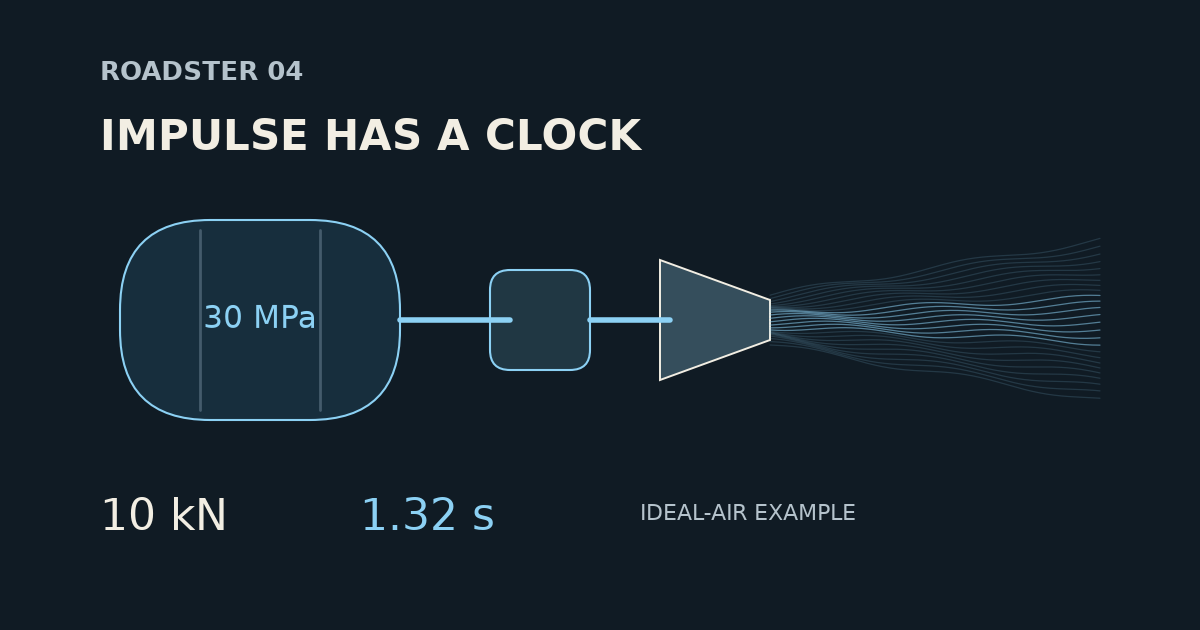
Start from L = 4.5 kN, R = 12 kN and T = 10 kN, with 26.5 kN total forward force and zero yaw moment. If the jet stops before the tyre-force difference changes, the compensating +6 kN·m remains. If the jet starts before compensation is established, the unmatched moment is −6 kN·m. Starting and stopping thrust therefore both require coordinated tyre-force transitions.初始取 L = 4.5 kN、R = 12 kN、T = 10 kN,纵向合力为 26.5 kN,偏航力矩为零。如果喷流先停止、轮胎差动力尚未改变,会留下 +6 kN·m 补偿力矩;如果喷流先建立、补偿尚未到位,未抵消力矩为 −6 kN·m。因此,推力的建立和撤除都需要协调轮胎力过渡。
Assume installed yaw inertia Iz = 3,000 kg·m² and a constant unmatched moment over delay τ. Integrating angular acceleration gives the yaw-rate increment Δr and heading increment Δψ. Initial increments and all other incremental moments are zero; tyre restoring response and the subsequent recovery are omitted.假定装车后的偏航转动惯量 Iz = 3,000 kg·m²,未抵消力矩在延迟 τ 内保持恒定。对角加速度积分,得到偏航角速度增量 Δr 和航向角增量 Δψ。初始增量及其他增量力矩均取零,暂不考虑轮胎恢复作用和后续恢复控制。


For a 100 ms delay, the yaw-rate increment is 0.2 rad/s, or 11.46°/s, and the heading increment is 0.573°. In this model, yaw-rate error is proportional to delay and heading error to its square. Returning net moment to zero stops the additional angular acceleration but leaves the accumulated yaw-rate error. Recovery requires an opposing angular impulse and sufficient actuator capacity to generate it.延迟为 100 ms 时,偏航角速度增量为 0.2 rad/s,即 11.46°/s,航向角增量为 0.573°。在本模型中,角速度误差与延迟成正比,航向角误差与延迟的平方成正比。将合力矩恢复为零,只会消除额外的角加速度,已积累的偏航角速度误差仍然存在。消除该误差还需要反向角冲量,以及产生该角冲量所需的执行器余量。
The delay budget includes sensing, filtering, fault detection, communication, computation and physical force buildup. Measure these contributions end to end. NASA research on actuator rate limiting discusses the relation between rate limits and effective phase lag in an aircraft-control simulation. The delays selected here are sensitivity cases, not Tesla measurements or safety thresholds. Assessing the vehicle trajectory and stability requires a closed-loop model and tests.延迟预算包括测量、滤波、故障检测、通信、计算以及实际力的建立,需要通过端到端测量确定。NASA 关于执行器速率限制的研究在飞行控制仿真中讨论了速率限制与有效相位滞后的关系。本节选取的延迟仅用于敏感性分析,并非 Tesla 实测数据或安全阈值;车辆轨迹与稳定性需要通过闭环模型和试验评估。
Force reallocation after capacity loss能力下降后的受力重分配
Let right-side longitudinal capacity fall from 12 to 8 kN while left-side capacity remains 12 kN. With instantaneous capacity clipping, actual R falls to 8 kN even before the command is updated. If L remains 4.5 kN and T remains 10 kN, the resulting forward force and yaw moment are 22.5 kN and −3.2 kN·m. In this simplified model, the force limit changes with capacity, independently of when the controller detects the loss.设右侧纵向力上限从 12 kN 降至 8 kN,左侧上限仍为 12 kN。采用能力瞬时截断模型时,即使指令尚未更新,实际 R 也降至 8 kN。若 L 仍为 4.5 kN、T 仍为 10 kN,纵向合力与偏航力矩分别为 22.5 kN 和 −3.2 kN·m。在这一简化模型中,实际力上限随能力变化更新,不取决于控制器何时检测到损失。
The new static zero-moment allocation is R = 8 kN and L = 0.5 kN, giving 18.5 kN total forward force. Reaching that point requires an actuator transition. Any yaw-rate error accumulated during the transition also requires a recovery demand. With the jet off, equal side forces can provide at most 16 kN at zero yaw moment. These calculations compare final static limits; they do not determine which transition satisfies vehicle-motion limits.新的静态零力矩分配为 R = 8 kN、L = 0.5 kN,纵向合力为 18.5 kN。执行器需要经过过渡过程才能到达该点;过渡期间积累的偏航角速度误差还需要额外恢复控制。关闭喷流时,在左右力相等、偏航力矩为零的条件下,纵向上限为 16 kN。上述计算比较的是最终静态能力,尚不能判断哪种过渡过程满足整车运动限制。
Unexpected jet shutdown requires removal of the previous tyre-force compensation. A stuck-open valve instead leaves thrust that may require an independent isolation path or continued compensation. A symmetric pair therefore needs separate analysis of nominal operation and one-sided failure. Fault-tolerant allocation research demonstrates demand redistribution using remaining actuator authority in vehicle simulation. Hardware validation additionally needs measured detection and isolation times, along with explicit limits on vehicle motion during recovery.喷流意外停止时,需要撤除原有轮胎差动力补偿。阀门卡在开启位置时,推力仍然存在,可能需要独立隔离路径或持续补偿。因此,对称喷口的正常工况与单侧失效应分别分析。公开的容错分配研究在车辆仿真中展示了利用剩余执行器能力重新分配需求的方法。硬件验证还需要实测检测与隔离时间,并明确恢复过程允许的整车运动范围。
Design recommendations and validation设计建议与验证要求
For the stated model, reduce thrust offset before increasing thrust magnitude. With d/b = 0.75, the marginal forward-force gain is 1 − d/b = 0.25 while the derived boundary remains valid. Reducing d lowers the compensating tyre-force difference without increasing nominal thrust. Geometry selection should therefore include forward capacity and yaw reserve, followed by checks of actuator timing and failure transitions.对本模型,建议优先减小推力偏置,再评估增加推力。在 d/b = 0.75、所推导边界仍适用时,每增加 1 kN 喷气力,纵向力上限仅增加 0.25 kN。减小 d 则可以在不增加名义推力的条件下,降低所需的轮胎差动力。布置选型应同时比较纵向能力和偏航余量,再验证执行时序与故障过渡。
| Decision决策 | Evidence to collect需要收集的证据 | Verification requirement验证要求 |
|---|---|---|
| Geometry and reserve布置与余量 | Evidence证据Measured thrust direction and lever arm; tyre combined-force maps; installed mass and actuator topology.实测推力方向与力臂、轮胎组合受力曲线、装车质量与执行器拓扑。 | Acceptance验收Meet the specified acceleration while retaining yaw-moment reserve in both directions over the defined operating range. Set the required margins from disturbance and recovery cases.在规定工况内满足目标加速度,同时保留双向偏航力矩余量;根据扰动与恢复工况确定所需裕量。 |
| Coordinated response协调响应 | Evidence证据Synchronized commands, measured forces, pressure and yaw rate; vary pressure, temperature and operating load.同步采集指令、实测受力、气压和偏航角速度,并改变供压、温度与工作负载。 | Acceptance验收Include timing uncertainty and verify that the resulting motion and recovery demand remain within predefined limits.计入时序不确定性,验证由此产生的运动响应与恢复需求满足预先定义的限制。 |
| Degraded operation故障降级 | Evidence证据Hardware-in-the-loop fault injection, then controlled proving-ground tests of grip loss, stale estimates and valve faults.硬件在环注入附着损失、过时估计与阀门故障,再进行受控试验场测试。 | Acceptance验收Complete the transition and recovery using only the remaining actuators, within their measured capacity and response limits.仅使用剩余执行器,在其实测能力与动态响应限制内完成过渡和恢复。 |
The calculation supports a geometry recommendation, not a complete control design. The offset-jet forward limit is 26.5 kN; at a 26 kN demand, only 0.4 kN·m of positive yaw reserve remains. The controller must account for this reserve when scheduling thrust and recovery. A vehicle-specific design still requires measured tyre limits, thrust geometry, yaw inertia and actuator response. Part 6 will examine repeated operation under thermal, gas-supply and recovery-time constraints.本次计算能够支持布置取舍,但尚未形成完整的控制设计。偏置喷流的纵向力上限为 26.5 kN;当需求为 26 kN 时,正向偏航余量仅剩 0.4 kN·m。控制器安排推力与恢复动作时,必须计入这项余量。针对实车的设计还需要实测轮胎能力、推力几何、偏航转动惯量和执行器响应。第六期将分析热量、供气与恢复时间约束下的重复运行能力。
The assumptions and computed cases accompany the figures. Checks cover force/moment balance, constraint boundaries, reserve and open-loop angular integration. No closed-loop Roadster simulation, hardware test or safety validation is claimed. Sources were checked on 23 October 2026.假设与计算结果随图提供。校验覆盖受力与力矩平衡、约束边界、余量及开环角运动积分;没有执行 Roadster 闭环仿真、实物试验或安全验证。资料核对日期为 2026 年 10 月 23 日。