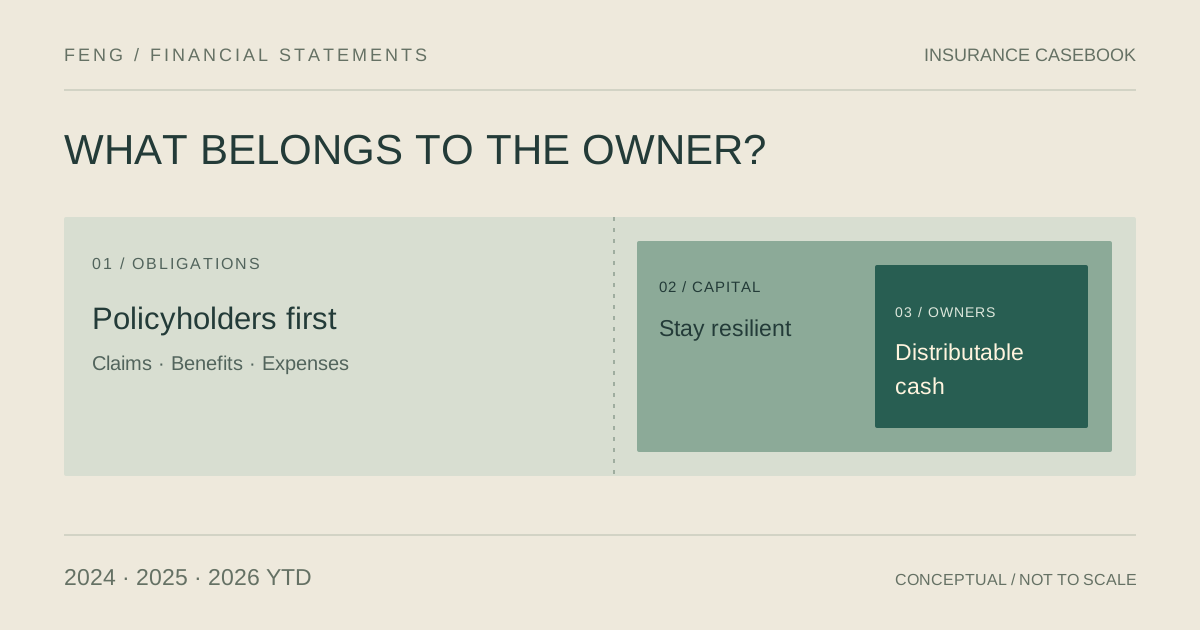
CPIC earned less reported profit in the first nine months of 2026, while its operating profit increased and its property-and-casualty underwriting ratio improved. An owner cannot explain this business with one growth rate. The task is to separate insurance operations, investment fluctuations and the cash that can reach shareholders.中国太保 2026 年前三季度归母净利润下降,营运利润却在增长,财险承保综合成本率也有所改善。一个增速解释不了这门生意。本期要学会把保险经营、投资波动与最终能够分给股东的现金分开。
One idea: Assess profit quality by separating the sources of earnings. Case · CPIC, FY2024–FY2025 and January–September 2026本期知识点:拆开利润来源,再判断盈利质量。真实案例 · 中国太保,2024—2025 全年及 2026 年前三季度
Why an insurer needs a different cash-flow reading保险公司的现金,为什么要换一种读法
A manufacturer usually receives cash after selling goods. An insurer receives premiums in exchange for obligations that may be settled years later. Investing that money is part of the business, but the balance is not entirely shareholder property. Claims, maturities, surrenders and capital requirements come before an unrestricted distribution. The earlier lesson’s CFO-minus-capex shortcut therefore cannot be carried over as insurance owner earnings.制造企业通常在交付商品后收款;保险公司收取保费,同时承担可能多年以后才履行的赔付与给付义务。运用这些资金投资是经营的一部分,但账上的钱并不全属于股东。赔款、满期给付、退保和资本要求,都约束着分配。因此,前面用“经营现金流减资本支出”估计现金的简式,不能直接套成保险公司的所有者收益。
The entity here is China Pacific Insurance (Group), A-share 601601 / H-share 02601. Life insurance and P&C insurance earn money differently: life policies accumulate long-duration obligations, while P&C analysis focuses more directly on claims and expenses relative to earned insurance revenue. Read the group’s profit together with the operating subsidiaries. This case was checked on 31 October 2026; 2026 figures below cover nine months, not a full year.本文研究的是中国太平洋保险(集团),A 股 601601、H 股 02601。寿险经营长期保障与储蓄型合同,财险则更直接地考验赔付、费用与保险服务收入之间的关系。阅读集团利润时,需要同时看子公司的经营指标。资料核对截至 2026 年 10 月 31 日;下文的 2026 年数据只覆盖前三季度。
Read the annual change through three earnings measures先用三种指标读懂全年变化
| Measure指标 | 2024 | 2025 |
|---|---|---|
| Group attributable net profit集团归母净利润 | 449.60 | 535.05 |
| Group attributable operating profit集团归母营运利润 | 344.25 | 365.23 |
| Life new-business value, NBV寿险新业务价值 NBV | 132.79 | 186.09 |
| Life NBV margin寿险新业务价值率 | 16.6% | 19.8% |
| P&C aggregate combined ratio财险业务承保综合成本率 | 98.6% | 97.6% |
| Net investment yield净投资收益率 | 3.8% | 3.4% |
| Total investment yield总投资收益率 | 5.6% | 5.7% |
Source: CPIC 2025 annual report, printed pp. 19–22; 2024 life figures use the restated comparative scope including CPIC Life Hong Kong.来源:太保 2025 年报,第 19—22 页;2024 年寿险数据采用包含太保寿险(香港)的重述比较口径。
Net profit describes the reported outcome; operating profit attempts to normalize part of its volatility. In 2025, net profit grew 19.0%, but operating profit grew 6.1%. CPIC defines operating profit by adjusting net profit for short-term investment fluctuations and specified one-off items. The investment adjustment uses a long-term return assumption. It is a useful analytical lens, not cash received and not a substitute for examining actual investment losses.净利润记录会计结果,营运利润则试图排除其中一部分波动。2025 年归母净利润增长 19.0%,营运利润增长 6.1%。太保以净利润为基础,调整短期投资波动及特定一次性项目;其中投资调整使用长期回报假设。这个指标有助于观察经营,但不是收到的现金,也不意味着实际投资损失可以被忽略。
NBV addresses a third question: how much actuarial value the year’s new life policies are estimated to create. Its 40.1% increase exceeds premium growth and accompanies a higher value margin. The report links this to channel development and product mix. It does not mean that RMB 18.609 billion was earned or collected for shareholders during 2025. The 2024 original report showed RMB 13.258 billion; the 2025 comparable column is RMB 13.279 billion after expanding the life scope to Hong Kong.新业务价值回答第三个问题:当年新卖出的寿险合同,预计为股东创造多少精算价值。2025 年它增长 40.1%,并伴随价值率提高;年报将变化联系到渠道发展与产品结构。这不等于股东当年已经收到或实现了 186.09 亿元收益。原 2024 年报的数字为 132.58 亿元,2025 年报纳入香港寿险业务后,将比较数重述为 132.79 亿元。
The P&C ratio tests underwriting discipline. A lower combined ratio means less of the relevant insurance revenue is consumed by the ratio’s claims, expenses and other defined underwriting components. The aggregate improvement from 98.6% to 97.6% includes a 0.4-point reduction in the loss ratio and a 0.6-point reduction in the expense ratio. Use the aggregate scope consistently: the standalone CPIC P&C legal entity reports 97.5%, a different perimeter.财险综合成本率检验承保纪律。在公司定义的口径下,比率越低,相关保险收入中被赔付、费用及其他承保项目消耗的比例越小。财险业务综合成本率从 98.6% 改善到 97.6%,其中赔付率下降 0.4 个百分点、费用率下降 0.6 个百分点。这里始终采用包含安信农险、太保香港的财险业务口径;单独的太保产险法人报出 97.5%,不能混用。
Investment returns also need decomposition. Net investment yield declined 0.4 percentage points, even as total yield edged up 0.1 point. Interest, dividends and rent alone therefore did not explain the stronger total return. Realized gains, fair-value changes and the changing investment mix must be examined before treating 2025’s profit growth as a durable run rate.投资回报也要拆开看。净投资收益率下降 0.4 个百分点,总投资收益率却上升 0.1 个百分点,说明利息、股息与租金本身不能解释整体回报改善。还要检查买卖价差、公允价值变化与资产结构,才能判断 2025 年的利润增幅有多少能够持续。
The next nine months test that interpretation用随后九个月检验这个解释
| Measure指标 | 2025 | 2026 |
|---|---|---|
| Group attributable net profit集团归母净利润 | 457.00 | 364.03 |
| Group attributable operating profit集团归母营运利润 | 284.74 | 300.81 |
| Life NBV寿险新业务价值 | 153.51 | 143.51 |
| Life scale premiums寿险规模保费 | 2,638.63 | 2,676.51 |
| P&C aggregate combined ratio财险业务承保综合成本率 | 97.6% | 96.2% |
| Total investment yield, not annualized总投资收益率,未年化 | 5.2% | 2.5% |
Source: CPIC 2026 Q3 report, pp. 3, 5–7 and 11. Figures are unaudited; the annual and nine-month blocks are separate comparisons.来源:太保 2026 年三季报,第 3、5—7、11 页。数据未经审计;全年与前三季度分别比较。
2025 operating profit and NBV amounts: CPIC 2025 Q3 report, p. 5; the 2026 report gives the corresponding growth direction/rates.2025 年营运利润及新业务价值绝对额:太保 2025 年三季报第 5 页;2026 年报告给出对应变动。
Different earnings questions give different answers同一家公司,三种收益指标给出不同答案
The reported-profit reversal is consistent with investment volatility: the non-annualized total investment yield fell from 5.2% to 2.5%, while the company attributes the profit decline to capital-market fluctuations. At the same time, operating profit grew 5.6% and the P&C combined ratio improved by 1.4 points. That combination does not support describing all insurance operations as deteriorating by 20.3%. It does show that shareholder results remain exposed to the investment portfolio.利润方向的反转与投资波动相吻合:未年化总投资收益率从 5.2% 降至 2.5%,公司也将利润下降归因于资本市场波动。与此同时,营运利润增长 5.6%,财险综合成本率改善 1.4 个百分点。这些证据不支持把“净利润下降 20.3%”翻译成“全部保险经营恶化 20.3%”;但它们说明,股东收益仍受投资组合影响。
Life insurance gives a separate warning. Scale premiums increased 1.4%, but NBV declined 6.5%. The report says agency-channel value continued growing, while bancassurance faced a high prior-year base and changes in product mix and market conditions. Follow value margins, renewal behavior and channel acquisition costs; more premium volume alone does not establish better economics.寿险则给出另一条需要追踪的信号:规模保费增长 1.4%,新业务价值却下降 6.5%。公司披露代理人渠道价值仍在增长,银保渠道受到上年高基数、产品结构及市场环境变化影响。下一步要追踪价值率、续期情况与获客费用,不能只凭保费规模增加判断生意变好。
Bridge group earnings to distributable shareholder cash从集团利润,走到能够分配的现金
In the 2025 report, group attributable profit was RMB 53.505 billion, but the parent legal entity earned RMB 11.537 billion. The proposed annual dividend was RMB 11.063 billion, based on the parent accounts and subject to the stated capital constraints. The holding company explains that its cash mainly comes from subsidiary dividends and its own investments. A large consolidated profit does not remove the need to move cash legally and prudently up through the group.2025 年报中,集团归母净利润为 535.05 亿元,母公司法人报表的净利润却为 115.37 亿元;拟分配年度现金股利为 110.63 亿元,以母公司报表及资本约束为依据。控股母公司的现金主要来自子公司股息与自身投资收益。集团账面赚得多,并不省略子公司能否依法、审慎上缴现金这一步。
| Measure指标 | 2024-12-31 | 2025-12-31 |
|---|---|---|
| Group集团 | 182% / 256% | 206% / 273% |
| Life legal entity太保寿险法人 | 130% / 210% | 157% / 228% |
| P&C legal entity太保产险法人 | 183% / 222% | 203% / 244% |
Source: 2025 annual report, pp. 42–43 and 60. The dividend was a proposal at the report date. Q3 2026 refers readers to separate solvency filings; these are explicitly year-end 2025 ratios.来源:2025 年报,第 42—43、60 页。股利为该报告时点的方案;2026 年三季报另引偿付能力报告,此表明确只列 2025 年末及其比较数。
The improved ratios show a larger disclosed capital cushion under the regulatory calculation, not an unrestricted cash reserve. CPIC attributes the changes to interest rates, capital markets, earnings and changes in business or investment allocation. A sound distribution assessment still needs subsidiary solvency, the parent’s cash and maturities, and sensitivity to adverse investment outcomes.比率提高说明监管计算下披露的资本缓冲扩大,不等于多了一笔可以任意分掉的现金。太保将变化联系到利率、资本市场、当期盈利,以及业务和资产配置变化。判断分红的可持续性,仍需核对子公司资本、母公司现金与到期义务,并测试不利投资情形。
Work through the case动手核对
Calculate 2025’s proposed dividend as a share of attributable net profit and operating profit. Which denominator gives the true dividend capacity?计算 2025 年拟分红占归母净利润、归母营运利润的比例。哪一个分母能直接告诉你真正的分红能力?
Check the reasoning核对推理
Using the rounded report amounts: 110.63 ÷ 535.05 = 20.7%; 110.63 ÷ 365.23 = 30.3%. Neither is a capacity test. They describe payout against two earnings measures. Capacity also depends on parent distributable reserves and cash, subsidiary upstream distributions and capital requirements.按年报取整数字:110.63 ÷ 535.05 = 20.7%;110.63 ÷ 365.23 = 30.3%。两个比例都不是分红能力测试,只是分红相对于两种收益口径的大小。真正的约束还包括母公司可分配利润及现金、子公司上缴能力和资本要求。
Underwriting improves while life new-business growth weakens承保改善,但寿险新业务增长承压
CPIC’s underwriting evidence is improving, but its latest life-business value growth has weakened. The 2026 nine-month combined ratio of 96.2% and operating-profit growth of 5.6% support a more resilient operating assessment than the 20.3% decline in reported profit alone suggests. The 6.5% fall in life NBV prevents a blanket conclusion that every business is improving.太保的承保经营有改善证据,但最新寿险价值增长有所走弱。2026 年前三季度财险综合成本率 96.2%、营运利润增长 5.6%,说明经营韧性比单看净利润下降 20.3% 得出的印象更强;寿险 NBV 下降 6.5%,则表明新业务增长仍有压力。
Valuation should reflect recurring distributable cash rather than a favorable year’s profit. The 2025 proposed dividend was 30.3% of operating profit, but that ratio does not establish surplus cash. The parent’s RMB 11.537 billion profit and the group’s RMB 53.505 billion profit belong to different accounts. A conservative valuation should start with sustainable insurance earnings, normalize investment returns over a range of conditions, then allow for additions to or releases of required capital and the ability of subsidiaries to send cash upstream. Using 2025 reported profit as an unchanged annual base would conceal the volatility visible in 2026.估值应以可持续分配的现金为依据,不能直接外推有利年份的利润。2025 年拟分红相当于营运利润的 30.3%,但这并不能证明剩下的都是闲置现金。母公司净利润 115.37 亿元与集团归母净利润 535.05 亿元,分属不同层面的账。保守估值应从可持续的保险收益出发,在不同市场条件下估计正常投资回报,再考虑必要资本的新增占用或释放,并核对子公司上划现金的能力。把 2025 年净利润原样当作今后的年度基数,会掩盖 2026 年已经显现的波动。
Capital allocation should reinforce the profitable underwriting business rather than force premium growth. A lower combined ratio is useful only if claims are adequately reserved and pricing remains sustainable. Life premiums rising while NBV falls is a reason to scrutinize product economics before celebrating sales. On the evidence examined here, retained capital earns no automatic presumption of good use: new policies and investments need to justify the capital they absorb, while dividends need to remain supportable after a less favorable investment year.资本配置应巩固有盈利能力的承保业务,而不是追求保费规模本身。综合成本率下降,只有在赔付准备充分、定价能够持续的前提下才有意义。寿险保费增加而 NBV 下降,要求先检查产品经济性,再评价销售增长。按本文已有证据,不能默认留存的资本一定用得好:新保单与投资都应解释所占资本能够获得什么回报,分红也应能承受投资年份转弱。
The inverse test is whether today’s attractive measures could conceal tomorrow’s cost. A better combined ratio could be less reassuring if it relied on reserve releases that later reverse; stable operating profit could be misleading if its assumed investment return became too optimistic. A sales system rewarded mainly for volume could also encourage business that consumes capital without creating enough value. These are mechanisms to test, not findings of misconduct: this case has not established such reserve behavior or remuneration arrangements. The relevant checks are claims development, the operating-profit reconciliation, and the actual sales and management incentive measures.逆向检验要问:今天好看的指标,会不会把成本留给明天?如果综合成本率改善依赖日后需要补回的准备金释放,含义就不同;如果营运利润采用的长期投资回报假设过于乐观,平稳也可能掩盖风险。若销售考核偏重规模,还可能鼓励消耗资本、价值不足的业务。这些是需要检验的机制,不是已经发现的违规事实:本文并未证实公司存在上述准备金行为或薪酬安排。应进一步核对赔款发展、营运利润调节过程,以及真实的销售和管理层考核指标。
For an existing holder, the decision rule is to recheck the business thesis, not react mechanically to the net-profit headline. At each comparable reporting period, record the P&C ratio and reserve development, life NBV and persistency, and subsidiary capital plus parent cash. If only investment marks weaken while those operating and capital indicators remain sound, the evidence primarily calls for a more conservative return estimate. If underwriting, policy value and the capacity to distribute cash deteriorate together, the operating thesis itself needs revision. A researcher should complete that reconciliation before converting an apparent earnings recovery into a higher valuation.对已有持仓的读者,可执行的规则是复核经营依据,而不是看到净利润标题就机械买卖。每逢同口径报告,记录财险综合成本率与赔款发展、寿险 NBV 与继续率,以及子公司资本和母公司现金。如果主要是投资估值转弱,而经营与资本仍稳健,首先需要下调的是过于乐观的回报估计;如果承保、保单价值和分配能力一起恶化,就应重估持有依据。研究者也应先完成这张核对表,再决定利润恢复是否值得更高的估值。
The present conclusion is therefore specific: CPIC merits further study for its insurance operations, while its purchase value remains conditional on a price that leaves room for investment volatility, life-business weakness and capital needs. No current A/H-share price or required return has been established here, so the evidence does not yet support a buy or add decision. The New China Life case examines the value assumptions more closely; the five-insurer comparison brings these distinct businesses together.因此,当前结论应落在具体位置:太保的保险经营值得继续研究,但买入价值取决于价格能否为投资波动、寿险走弱和资本需求留下余地。本文尚未核定当前 A/H 股价格及所需回报率,现有证据还不足以形成买入或加仓结论。下一期用新华保险进一步检验价值假设,再在五家险企对照中综合比较。